Bangladesh Cabinet reshuffle: Performance-based or political move?
Six months after Bangladesh's new government formed, a cabinet reshuffle has raised questions about performance versus political expediency. Analysts weigh in on the changes and the size of the expanded cabinet.
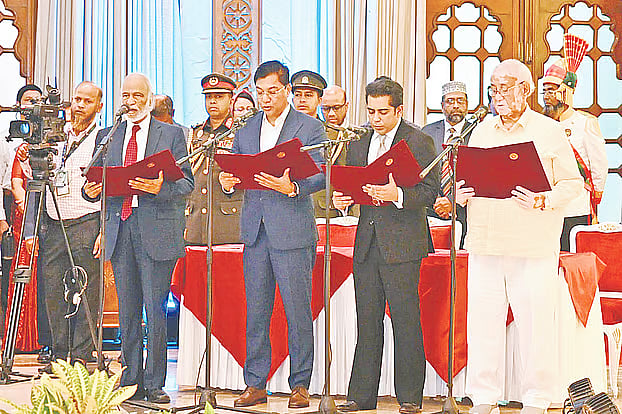
Prime Minister Tarique Rahman instructed each ministry to submit a 180-day action plan during the first Cabinet meeting, suggesting a six-month period to assess performance and efficiency. Six months later, the government has reshuffled the Cabinet, appointing four new ministers and two state ministers, while reassigning responsibilities in one ministry. One minister was removed and made a Prime Minister's adviser.
The Cabinet now consists of 51 ministers, along with 13 advisers and special assistants holding ministerial or state ministerial rank, totaling 64 members. This makes it the second-largest Cabinet in Bangladesh's history, after the Awami League government's Cabinet of 70 members post-2008.
The reshuffle and appointments raise questions about the government's evaluation process. The Prime Minister had asked for 180-day action plans, leading many to expect a performance-based evaluation. However, the changes seem more like an expansion or reconfiguration than a reshuffle.
Two notable changes include the minister for Civil Aviation and Tourism being reassigned to the Ministry of Food, with the state minister elevated to a full minister. It remains unclear whether this reflects performance assessments or other considerations. Similarly, the Minister of Information was removed and appointed as a ministerial adviser to the Prime Minister, prompting questions about the reasons behind this move.
While the Prime Minister has the constitutional and political prerogative to reshuffle the Cabinet, the public expects a connection between the six-month performance evaluation and the changes. The government has not provided a clear explanation, leading observers to view the changes as a Cabinet expansion rather than a performance-based reshuffle.
Assessing ministerial performance is complex and involves multiple factors. These include achieving ministry objectives, decision-making quality and speed, administrative efficiency, proper use of public funds, citizen satisfaction, and accountability to Parliament. Ministerial actions and statements that damage the government's image are also crucial considerations.
Over the past six months, several controversies have emerged involving ministers, with some decisions and statements being withdrawn and the Prime Minister intervening in certain cases. Allegations of irregularities, corruption, and nepotism have also been made.
The government's three priorities—controlling essential commodity prices, improving law and order, and restoring normal electricity and fuel supply—have not seen significant progress. However, six months is a relatively short period for a new government to address inherited problems and organize the administration.
The reshuffle could have reflected an assessment of performance, but the changes do not clearly indicate this. Further reshuffles may be expected, as reports suggest these changes may not be final. The large Cabinet size also raises concerns about efficiency and coordination, with experts advocating for a smaller, more effective Cabinet.
The government's large Cabinet may be an effort to recognize and reward the party's long-standing leaders who faced repression and made sacrifices. However, effective governance and efficiency should remain the primary considerations.
Managing a large Cabinet presents challenges in supervision and accountability. Additionally, not all ministers appear to fully align with the political culture the Prime Minister is promoting. Addressing these gaps is essential for the government's effectiveness.
Comments (0)
No comments yet — be the first to weigh in.

Mumbai’s Vile Parle Cypher is giving unheard rappers a voice
A new documentary streaming on YouTube sheds light on the Vile Parle Cypher, a grassroots hip-hop collective giving a platform to unheard street artists and gig...

Enrich and Ultimo impress
Racehorses Enrich and Ultimo Impress in Tuesday Morning Workouts at Bengaluru Turf Club BENGALURU, Sept 1 – Two rising stars in India’s horse racing circuit, En...

Karnataka CM Signals Review of 5% Park Land Amendment Bill in Assembly
Karnataka Chief Minister D.K. Shivakumar says the controversial 5% park land amendment bill can be re‑examined in the Assembly after protests over Lalbagh land use.

When an organisation deviates from its values, faith of those associated with its ideology is shattered: Kaushal Kishore
Former Union Minister and senior Bharatiya Janata Party (BJP) leader Kaushal Kishore suggested on September 1, 2026, that organizations risk losing public trust...
Mumbai’s Vile Parle Cypher is giving unheard rappers a voice
Enrich and Ultimo impress
Karnataka CM Signals Review of 5% Park Land Amendment Bill in Assembly
