Bangladesh's enforced disappearance investigations face scrutiny amid new bill
Questions arise over independence of investigations into enforced disappearances in Bangladesh, as new bill transfers control from National Human Rights Commission to government agencies.
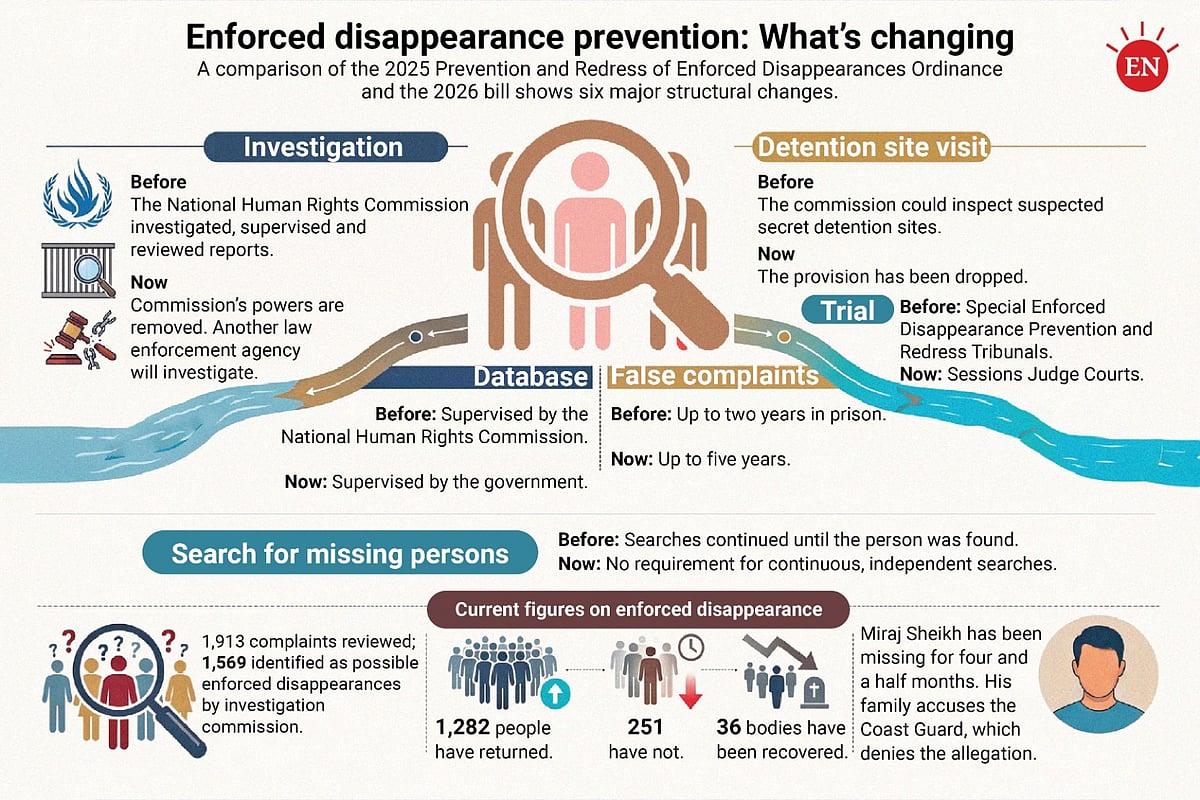
Questions arise over the independence and effectiveness of investigations into enforced disappearances in Bangladesh as cases like that of Miraj Sheikh of Mongla in Bagerhat remain unresolved. Sheikh's family has accused Coast Guard personnel of detaining him on April 10, a claim the Coast Guard denies. Despite multiple efforts, including a High Court order on July 12 to produce Sheikh within 15 days, his whereabouts remain unknown more than four months later.
Home Minister Salahuddin Ahmed stated on August 25 that no enforced disappearances or extrajudicial killings have occurred since the current government took office, a claim made during a meeting with the UN Development Programme’s resident representative at the Secretariat. However, the case of Miraj Sheikh underscores ongoing concerns about accountability and the investigative process.
The Prevention and Remedy of Enforced Disappearance Bill, 2026, recently tabled in parliament by the Bangladesh Nationalist Party (BNP) government, proposes changes to the investigative framework. Under the 2025 ordinance issued by the interim government, the National Human Rights Commission (NHRC) had authority to investigate allegations of enforced disappearance, including the power to inspect suspected detention centers. The new bill shifts control of criminal investigations away from the NHRC, instead allowing the government to assign investigations to another disciplinary force or inter-agency team if a force is accused.
Critics argue that while the bill removes the accused force from investigating itself, the new framework still places investigations within the state’s disciplinary structure, with the government deciding who conducts the probe. This raises questions about the independence of such investigations. The NHRC’s former role in overseeing inquiries and maintaining a centralized database is notably absent in the new bill.
Today, August 30, marks the International Day of the Victims of Enforced Disappearances, with this year’s theme being ‘Victims first, Actions Now.’ The day also commemorates two years since Bangladesh ratified the International Convention for the Protection of All Persons from Enforced Disappearance (ICPPED).
Enforced disappearances became a significant issue during the Awami League’s 15-and-a-half-year rule, with documented cases rising from 10 in 2009 to 34 in 2010. The issue gained prominence after BNP leader Chowdhury Alam’s disappearance in June 2010. The scale of such cases expanded notably around 2013–14, with political leaders and activists disproportionately affected.
Following the fall of the Awami League government, an interim government formed the Commission of Inquiry on Enforced Disappearances on August 27, 2024, led by retired Justice Moinul Islam Chowdhury. The commission was tasked with investigating disappearances between January 6, 2009, and August 5, 2024, identifying 1,569 cases. Of these, 1,282 individuals were later released, 251 remain missing, and 36 have been found deceased. The commission estimates the actual number of cases could be between 4,000 and 6,000.
A major challenge identified by the commission was the lack of documentary evidence in most cases, primarily due to police stations refusing to register general diaries (GDs). The strongest evidence of involvement in enforced disappearances was found against agencies including the Rapid Action Battalion (RAB), police, Detective Branch (DB), Counter Terrorism and Transnational Crime (CTTC), Directorate General of Forces Intelligence (DGFI), and National Security Intelligence (NSI).
The interim government’s Enforced Disappearance Prevention and Redress Ordinance-2025, issued on December 1, 2025, aimed to address these gaps by centralizing investigations under the NHRC. Complaints could be filed directly with the commission, which was empowered to investigate, inspect detention facilities, and maintain a central database. However, the ordinance lapsed on April 11, 2025, after failing to secure parliamentary approval. The BNP government subsequently introduced a new draft law on July 27, which was approved by the cabinet on August 3 and tabled in parliament on August 27. Opposition lawmakers staged a walkout, alleging the bill did not adequately address concerns about accountability.
#EnforcedDisappearances #Bangladesh #HumanRights #NationalHumanRightsCommission #ICPPED #MirajSheikh #PreventionAndRemedyBill
Comments (0)
No comments yet — be the first to weigh in.

Mumbai’s Vile Parle Cypher is giving unheard rappers a voice
A new documentary streaming on YouTube sheds light on the Vile Parle Cypher, a grassroots hip-hop collective giving a platform to unheard street artists and gig...

Enrich and Ultimo impress
Racehorses Enrich and Ultimo Impress in Tuesday Morning Workouts at Bengaluru Turf Club BENGALURU, Sept 1 – Two rising stars in India’s horse racing circuit, En...

Karnataka CM Signals Review of 5% Park Land Amendment Bill in Assembly
Karnataka Chief Minister D.K. Shivakumar says the controversial 5% park land amendment bill can be re‑examined in the Assembly after protests over Lalbagh land use.

When an organisation deviates from its values, faith of those associated with its ideology is shattered: Kaushal Kishore
Former Union Minister and senior Bharatiya Janata Party (BJP) leader Kaushal Kishore suggested on September 1, 2026, that organizations risk losing public trust...
Mumbai’s Vile Parle Cypher is giving unheard rappers a voice
Enrich and Ultimo impress
Karnataka CM Signals Review of 5% Park Land Amendment Bill in Assembly
