Why Liberals Must Urgently Address the U.S. National Debt Crisis
Explore why rising U.S. national debt threatens liberal priorities, from Medicare for All to consumer loans, and what progressives must do to avert fiscal disaster.
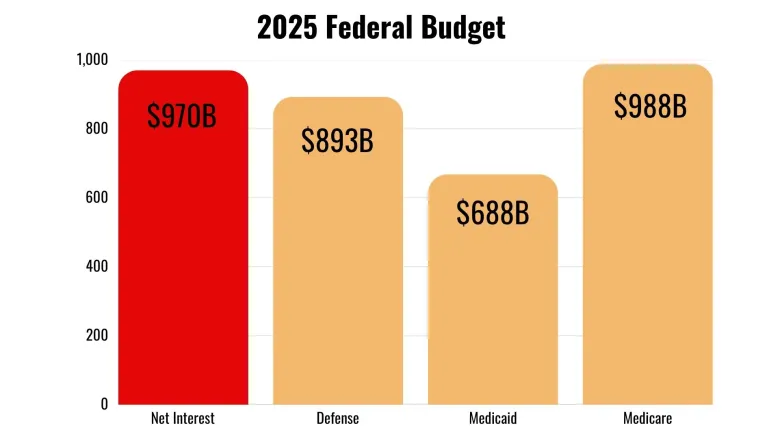
The U.S. national debt has surged past $40 trillion, a milestone that has drawn widespread attention but sparked limited concern among many liberals. While some progressive economists and policymakers argue that deficits are less consequential due to tools like Modern Monetary Theory, others remain unconvinced, viewing the debt as either a bargaining chip for taxing the wealthy or a pressing issue requiring structural reform. The reality, however, is that the nation’s fiscal trajectory poses real risks that cannot be ignored, particularly as interest payments on the debt continue to balloon.
Interest costs alone reached $970 billion in 2025, surpassing federal spending on defense and nearly matching expenditures for Medicaid and Medicare, according to the Congressional Budget Office. Over the next decade, interest payments are projected to total $16.2 trillion—enough to fund Medicare for All for four consecutive years. These costs divert critical resources away from progressive priorities, including social programs and public investments. Meanwhile, rising debt has made the U.S. a less attractive borrower, driving up Treasury yields to their highest levels in 25 years. This, in turn, has increased borrowing costs for consumers, adding roughly $2,500 annually to the cost of a median-priced 30-year mortgage compared to 2015, according to the Yale Budget Lab.
Progressives have historically dismissed deficit concerns as overblown, citing the hypocrisy of conservative lawmakers who advocate austerity while pushing tax cuts for the wealthy. Examples include President Ronald Reagan’s welfare cuts alongside $1.8 trillion in tax reductions that expanded the debt, and President Donald Trump’s repeated calls to slash programs like Medicaid while enacting tax breaks projected to add $3.4 trillion to deficits over a decade. Yet the current fiscal situation demands a more serious reckoning. Reversing past tax cuts for the highest earners, though necessary, will not fully address the structural imbalance.
Economists like Rob Shapiro, writing for *Washington Monthly*, have highlighted the long-term damage of unchecked debt growth, which risks crowding out public investment and reducing the nation’s economic resilience. For liberals, the challenge is balancing fiscal responsibility with the pursuit of equitable policies. Ignoring the debt’s trajectory risks not only higher borrowing costs but also diminished capacity to fund transformative programs. The path forward will require difficult choices, including reforms to tax policy, spending priorities, and economic growth strategies.
The debate over the national debt intersects with broader discussions about governance, as argued by David Masciotra in *Washington Monthly*, who warns against reflexive attacks on expertise and institutional experience. Progressives, he suggests, must articulate a vision of government that leverages competence without surrendering to partisan cynicism.
#NationalDebt #ProgressivePolicy #FiscalResponsibility #EconomicPolicy #USFinance #LiberalEconomics #InterestRates
Comments (0)
No comments yet — be the first to weigh in.

Middlesbrough's Crime Crisis: Decades of Failed Policies Unleash Chaos
Former Middlesbrough mayor Andy Preston blames decades of lenient crime policies for the town's recent surge in gang violence and lawlessness.

Google Maps Renames Lake Ontario to 'Lake America' Following Trump Order
Google Maps now displays 'Lake America' in the US, replacing 'Lake Ontario' after Trump's executive order amid trade tensions with Canada. Canadians still see the original name.

Pentagon Warns Pentagon Chiefs: Iran War Unsustainable, Threatens U.S. Readiness
Classified assessment reveals Pentagon chiefs warn Defense Secretary Pete Hegseth that the Iran war is unsustainable and drains U.S. military resources and readiness.

Mike Rogers Proposes $50 Copays for Routine Health Screenings, Critics Warn of Risks
Former Congressman Mike Rogers suggests $50 copays for routine screenings, sparking debate over healthcare costs and access. Critics highlight potential risks.

Mumbai’s Vile Parle Cypher is giving unheard rappers a voice

Enrich and Ultimo impress

Karnataka CM Signals Review of 5% Park Land Amendment Bill in Assembly

