Yayoi Kusama, Legendary Infinity Artist, Dies at 97
Japanese artist Yayoi Kusama, renowned for her iconic Infinity Rooms and vibrant polka-dot works, has died at 97. Her death was confirmed by her studio and David Zwirner Gallery.
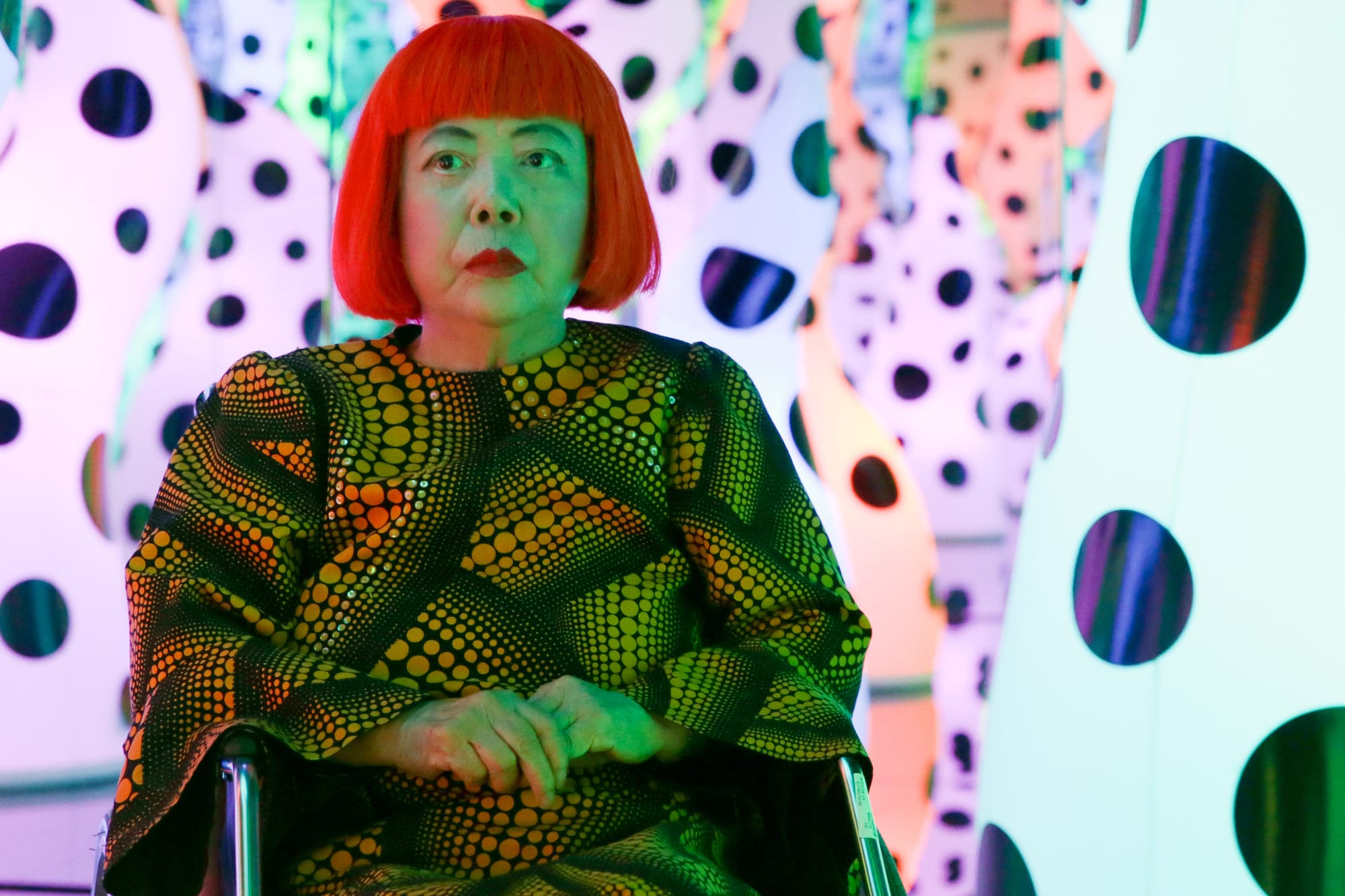
Legendary Japanese artist Yayoi Kusama, renowned for her mesmerizing polka-dot patterns and immersive Infinity Rooms, died on August 14 in a Tokyo hospital. She was 97. The announcement was made by her studio and David Zwirner Gallery on August 26. Kusama’s legacy spans seven decades of groundbreaking work that blended psychological depth, avant-garde experimentation, and unrelenting creativity.
Born in 1929 in Matsumoto, Japan, Kusama began painting as a child to cope with hallucinations and family turmoil. Despite early resistance from her family, she pursued art, studying Nihonga at the Kyoto School of Arts and Crafts before relocating to New York City in 1958. There, she emerged as a central figure in the 1960s avant-garde scene, collaborating with peers like Eva Hesse and Donald Judd while developing her signature Infinity Nets series. These hypnotic, repetitive paintings reflected her lifelong fascination with infinity and the cosmos.
Kusama’s innovative practice extended beyond painting. She pioneered immersive environments, including the now-iconic Infinity Rooms, which use mirrors and lights to create disorienting, boundless spaces. These installations, first shown in the 1960s, have since drawn global crowds, becoming viral sensations synonymous with contemporary experiential art. Her Accumulation sculptures, featuring everyday objects covered in phallic forms, challenged artistic conventions and sparked dialogue on sexuality and consumerism.
Beyond art, Kusama was a bold activist. In the late 1960s, she organized anti-war protests, including a 1968 naked demonstration outside the New York Stock Exchange. Her radical performances, often involving nudity and polka dots, used the body as a medium for political and social critique.
In 1973, Kusama returned to Japan, where she voluntarily entered a mental health facility in Tokyo. Far from retiring, she maintained a rigorous studio practice, producing some of her most celebrated works, including her monumental dotted pumpkins and psychedelic florals. Her fame surged in the 1990s, culminating in her historic participation in the 1993 Venice Biennale.
Kusama’s influence permeates modern art, from Minimalism to Pop Art to today’s experiential installations. Her work has been exhibited worldwide, with recent retrospectives drawing record attendance, including a career-spanning show at Museum Ludwig in Cologne. Despite controversies—including past racist remarks in her 2002 autobiography—Kusama remained a polarizing yet irreplaceable figure.
In her final years, she continued painting daily, embodying her lifelong mantra of artistic devotion. “I’ve sought for truth of art with an ambition and fought like hell all my life,” she told Tate in 2015. “I want younger people to talk about my enthusiasm reaching to space.”
#YayoiKusama #JapaneseArtist #InfinityRooms #ModernArt #AvantGarde #MentalHealthAwareness #ContemporaryArt
Comments (0)
No comments yet — be the first to weigh in.

Yayoi Kusama’s Death Signals a Kind Fall for Art and Humanity
Hyperallergic reflects on the passing of Yayoi Kusama, Dolly Parton, and Sliman Mansour, while exploring loneliness, AI, and art's role in a changing world.

Tessa Hulls on Her Graphic Memoir 'Feeding Ghosts' on Longform Podcast #571
Writer and artist Tessa Hulls discusses her graphic memoir Feeding Ghosts and the project she spent her life avoiding, on Longform Podcast #571.
Derek Thompson on Longform Podcast: Solving Life's Mysteries Through Writing
Derek Thompson, Atlantic staff writer and Plain English host, discusses his career as a 'dilettante' and love for uncovering mysteries in his Longform Podcast interview.
Rozina Ali on Longform Podcast #573 Discussing Her Career and Reporting
Rozina Ali, a New York Times Magazine writer and National Magazine Award winner, joins the Longform Podcast to discuss her career and latest reporting.

Mumbai’s Vile Parle Cypher is giving unheard rappers a voice

Enrich and Ultimo impress

Karnataka CM Signals Review of 5% Park Land Amendment Bill in Assembly

