Scientists Discover Rare Backward-Walking Sea Robin Fish in Deep Sea
Marine biologists document armored sea robins using unique fin rays to walk, even backwards, in the South China Sea, revealing new deep-sea adaptations.
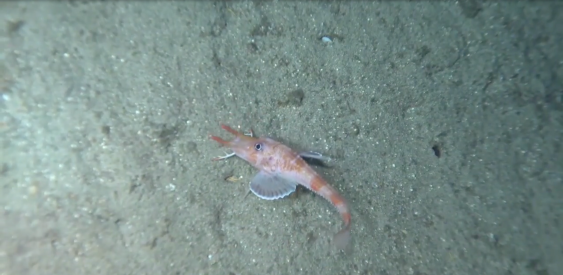
Marine biologists from Sun Yat-sen University in China have documented previously unknown behaviors in three species of armored sea robins, deep-sea fish that inhabit the ocean floor in the South China Sea. Using a submersible, the researchers captured video footage that reveals how these unusual fish use specialized fins to walk both sideways and backward.
The findings, published in the journal Ocean-Land-Atmosphere Research, confirm that sea robins rely on their pectoral fin rays—highly mobile, stiff appendages that extend from the fish’s sides—to move across the seafloor. Unlike typical fish fins, these fin rays function independently, allowing the armored sea robin to maneuver with precision. One species, *Scalicus engyceros*, was observed scuttling sideways and even moving in reverse, a behavior not previously documented in these fish.
The study also highlights structural adaptations that aid the sea robin in its deep-sea foraging. The fish’s pectoral fins have evolved into rounded, skirt-like plates that provide stability while it probes the seafloor for food. Its snout is similarly specialized, featuring paired protrusions resembling tuning-fork prongs and rake-like appendages that extend outward. Researchers suggest these structures help the fish detect and extract prey buried in sediment.
The expedition offered new insights into the sea robin’s sensory capabilities. While the fish showed little reaction to the presence of the deep-sea vehicle, they responded to artificial light by shifting their gaze. This suggests that, despite living in near-total darkness, their eyes retain some light-sensing function.
Study author Han Tian emphasized the broader implications of the research, stating that armored sea robins exhibit far more unique behavioral and evolutionary adaptations than previously recognized. “Ultimately, this research will reshape scientific perceptions of deep-sea biodiversity and reveal how extreme marine environments drive the emergence of one-of-a-kind biological structures and behaviors unseen in any other aquatic organism on Earth,” Tian said.
The discovery underscores the complexity of deep-sea ecosystems and the challenges researchers face in studying them. By documenting these previously unobserved behaviors, the study contributes to a growing body of knowledge about life in one of Earth’s most inaccessible environments.
Comments (0)
No comments yet — be the first to weigh in.

NASA Launches Nancy Grace Roman Telescope to Unlock Universe's Mysteries
NASA's new Nancy Grace Roman Space Telescope lifts off from Florida to study dark energy, exoplanets, and cosmic mysteries with unprecedented precision and scope.

Nature reserves spot rare species during heatwaves
Nature reserves in Hertfordshire and Middlesex have documented rare species this summer, with volunteers spotting wildlife not seen in decades and some even for...

Inmates at HMP La Moye craft boxes to save Jersey's hedgehogs
Prisoners at HMP La Moye have crafted nesting and feeding boxes to support Jersey's hedgehog population, boosting rehabilitation and community engagement.

2026 Nepal Flood: Ice‑Rock Avalanche, Glacial Lake Outburst and Climate‑Change Risks
A massive ice‑rock avalanche triggered a catastrophic flood in Nepal on Aug. 26 2026, followed by a glacial lake outburst that devastated towns and hydropower plants. Climate‑change‑driven thawing increased the risk.

Mumbai’s Vile Parle Cypher is giving unheard rappers a voice

Enrich and Ultimo impress

Karnataka CM Signals Review of 5% Park Land Amendment Bill in Assembly

