Study Warns Climate Change Strengthens El Niño, Creating Vicious Cycle
New research reveals how climate change is intensifying El Niño events, amplifying global warming in a dangerous feedback loop with severe consequences for weather patterns and food security.
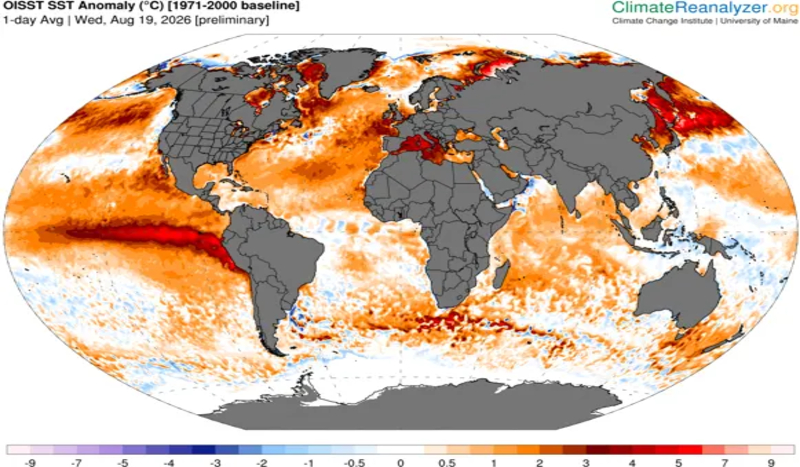
A new study published in the journal Science reveals an intensifying feedback loop between human-driven global warming and El Niño weather patterns. Led by climate scientist Judith Cole of the University of Michigan, the research indicates that rising global temperatures are making El Niño events significantly stronger, while intensified El Niño cycles are simultaneously accelerating global heating.
To reach their conclusions, researchers analyzed boulder-like coral fossil deposits from the Galápagos Islands off the coast of Ecuador. By examining the chemical composition of thousand-year-old coral samples to determine past sea surface temperatures, the team reconstructed historical ocean conditions in the Equatorial Pacific. The data revealed that El Niño variability has surged by approximately 37 percent over the past 40 years compared to pre-industrial times.
Cole noted that recent El Niño activity marks a distinct shift from pre-industrial norms, driven by anthropogenic climate change rather than natural ocean fluctuations. Study co-author Samantha Stevenson-Karl, a scientist at the University of California, Santa Barbara, stated that the findings provide a strong indication that the climate crisis is already amplifying El Niño events, suggesting that severe weather phenomena will become more frequent in the future.
The findings coincide with observations from preeminent climate scientist Dr. James Hansen, who noted that heat anomalies in the upper 300 meters of the Equatorial Pacific Ocean have recently surpassed historic record levels set during the 1997-98 super El Niño. Hansen warned that unchecked human-made climate forcings will intensify extreme heat and drought, threatening living conditions across South Asia, Africa, Gulf nations, and the Southwest United States.
The humanitarian and economic consequences of stronger El Niño events are already unfolding worldwide. Heavier rainfall and flooding are expected in South America and the southern United States, while India, Indonesia, and Australia face weakened monsoons and severe drought. According to the United Nations World Food Programme, the current El Niño event could push roughly 50 million people globally into acute hunger due to disruptions in food production.
Texas A&M University climate scientist Andrew Dessler, who was not involved in the research, described the paper as an important validation of climate models predicting stronger El Niño cycles. Dessler stressed that the findings reinforce the urgent necessity to transition away from a fossil fuel-driven economy to climate-safe renewable energy. Cole similarly emphasized that while nations must adapt by stockpiling food and preparing infrastructure, mitigating future climate hazards requires rapidly eliminating greenhouse gas emissions.
#ClimateChange #ElNino #Ecuador #JudithCole #JamesHansen #Science #GlobalWarming
Comments (0)
No comments yet — be the first to weigh in.

Bentley Torcal: First All-Electric SUV Unveiling & Price Details
Bentley Motors will unveil its first all-electric SUV, the Torcal, on September 23. Discover pricing, features, and how it compares to competitors in the luxury EV market.

How King Harald V of Norway quietly led the world in clean tech adoption
King Harald V of Norway passed away in 2026 after a 35-year reign marked by stealth advocacy for clean technology, particularly electric vehicles, without political interference.

Why Gas Cars Could Be Worth Less Than Zero by 2031 in the US
Analyzing how cheap used EVs may make gasoline cars uneconomical in the US by 2031, with insights from Norway and China's used-car markets.

XPeng Advances AI Tech with VLA 2.0 Upgrade & Robotaxi Progress
XPeng's latest VLA 2.0 upgrade enhances intelligent driving with 4D perception, 20x safety boost, and voice-controlled robotaxis. Discover XPeng's AI advancements.

Mumbai’s Vile Parle Cypher is giving unheard rappers a voice

Enrich and Ultimo impress

Karnataka CM Signals Review of 5% Park Land Amendment Bill in Assembly

