The First Moon Spaceport Is Coming. But First We’ll Need Moon Traffic Control
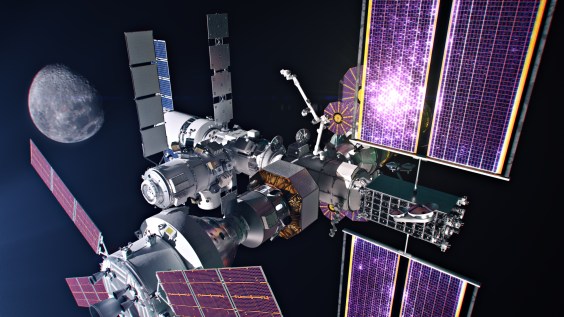
The first lunar spaceport is planned for operation within two decades, according to NASA, but ensuring safe and efficient operations will require an advanced air traffic control system for the moon. Researchers from Texas A&M University, NASA Johnson Space Center, and Purdue University have outlined how such a system might function in a study published in Acta Astronautica.
The proposed system would manage multiple spacecraft sharing the same Near Rectilinear Halo Orbit (NRHO), an elliptical route that will serve as the primary approach for docking with the Gateway spaceport. This orbit passes within 1,000 miles of the moon’s north pole and swings out to 40,000 miles from the south pole. Diane Davis, an associate professor of space engineering at Texas A&M, noted that the NRHO provides a nearly stable, highly elongated orbit around the moon with consistent communication links to Earth and requires minimal propellant to maintain.
However, navigating this orbit presents significant challenges. Spacecraft in the NRHO will experience competing gravitational forces from Earth and the moon, and the proximity of multiple missions increases the risk of collisions or unintended course deviations. Precision maneuvering is essential to avoid such hazards, particularly given the limited fuel available for corrective actions.
To address these challenges, the research team proposed a coordinated approach where spacecraft maintain a "string of pearls" formation, sharing data and continuously recalculating their positions relative to the Gateway. This method ensures safe distances between vehicles and accounts for realistic navigation errors, thruster imperfections, and other disturbances. While this approach requires slightly more fuel to maintain precise orbits, the researchers found that the increased predictability is a worthwhile trade-off.
"The future of lunar exploration depends as much on the traffic management as it does on the rocket science," Davis stated.
The Gateway spaceport, a key component of NASA’s Artemis program, is expected to take several decades to construct. The proposed lunar air traffic control system would operate alongside it, ensuring safe and orderly operations in the NRHO. Further details on operational logistics, such as in-flight services, have not yet been announced.
Comments (0)
No comments yet — be the first to weigh in.

NASA Launches Nancy Grace Roman Telescope to Unlock Universe's Mysteries
NASA's new Nancy Grace Roman Space Telescope lifts off from Florida to study dark energy, exoplanets, and cosmic mysteries with unprecedented precision and scope.

Nature reserves spot rare species during heatwaves
Nature reserves in Hertfordshire and Middlesex have documented rare species this summer, with volunteers spotting wildlife not seen in decades and some even for...

Inmates at HMP La Moye craft boxes to save Jersey's hedgehogs
Prisoners at HMP La Moye have crafted nesting and feeding boxes to support Jersey's hedgehog population, boosting rehabilitation and community engagement.

2026 Nepal Flood: Ice‑Rock Avalanche, Glacial Lake Outburst and Climate‑Change Risks
A massive ice‑rock avalanche triggered a catastrophic flood in Nepal on Aug. 26 2026, followed by a glacial lake outburst that devastated towns and hydropower plants. Climate‑change‑driven thawing increased the risk.

Mumbai’s Vile Parle Cypher is giving unheard rappers a voice

Enrich and Ultimo impress

Karnataka CM Signals Review of 5% Park Land Amendment Bill in Assembly

