Vycarb Successfully Stores Low-Purity CO2 In Seawater
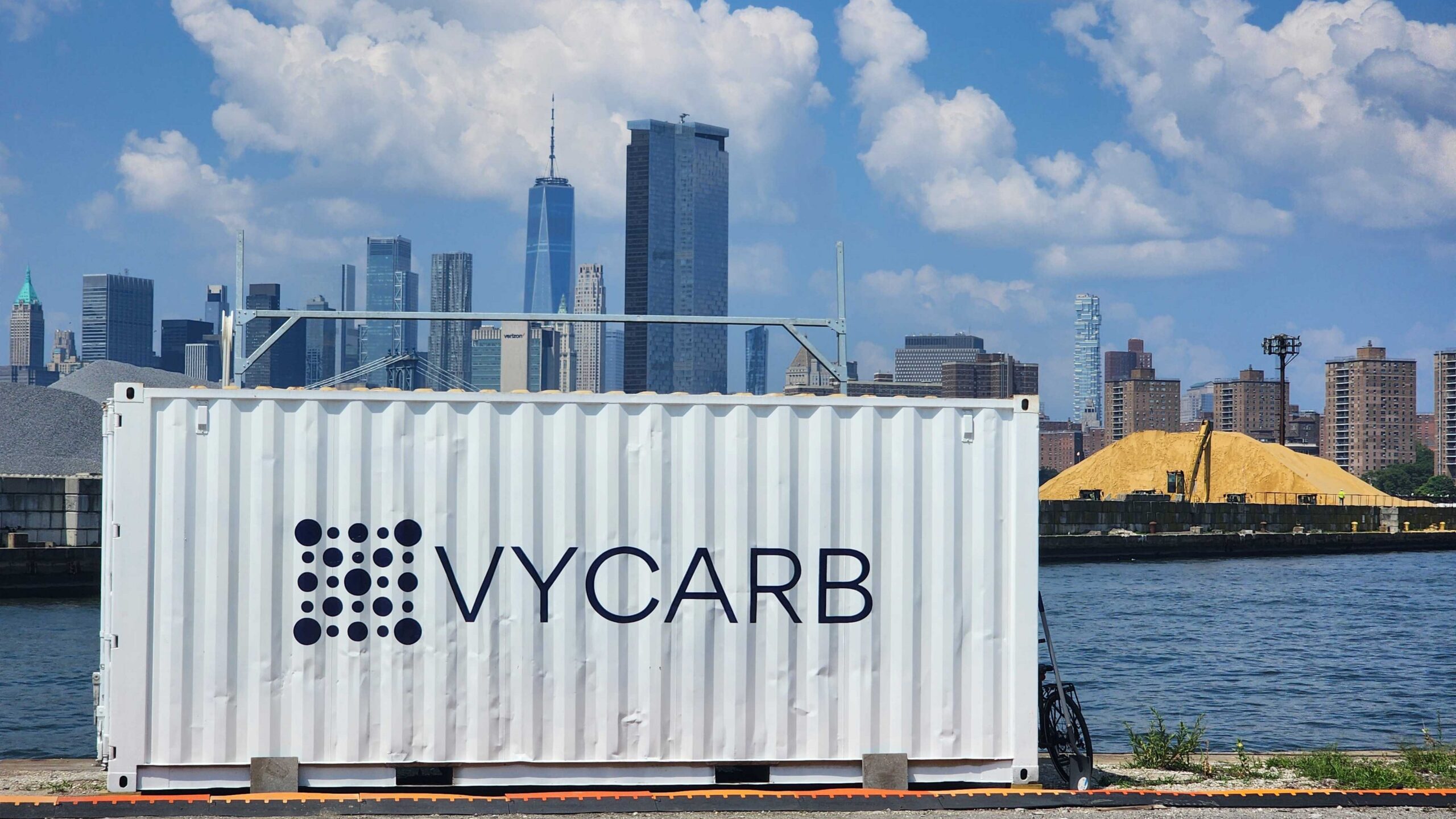
Vycarb, a Brooklyn-based startup, has achieved a major breakthrough in carbon capture and storage (CCS) technology by successfully storing low-purity carbon dioxide (CO2) in seawater. The company, founded in 2022, is based at the Brooklyn Navy Yard and is currently running a pilot project on the East River, demonstrating promising results for large-scale commercialization.
Vycarb’s innovative approach addresses a key challenge in CCS: the high cost and complexity of purifying CO2 before storage. Traditional methods require compressing and transporting purified CO2 to geologic formations, often making the process impractical. Vycarb’s system bypasses these steps by using ocean-based chemistry and real-time sensor technology to store CO2 as stable dissolved bicarbonate (HCO3-). This method leverages inexpensive, abundant alkaline minerals and minimal power consumption, making it a cost-effective and accessible solution.
Recent test results show that Vycarb can incorporate up to 99% of CO2 gas into water, even when the CO2 purity is as low as 50%. Of the incorporated CO2, 85% is converted into soluble bicarbonate, exceeding initial targets. The company is now aiming to validate 99% CO2 water incorporation at just 10% purity, having already achieved results as low as 1.5% in laboratory settings. This means industrial emitters could use CO2 concentrations as low as those found in fossil fuel exhaust gases, eliminating the need for additional purification.
Dr. Garrett Boudinot, Vycarb’s CEO and founder, emphasized the significance of the findings: “Every industrial emitter we talk to faces the same problem: capturing and purifying CO2 before it can ever be stored is often the most expensive and technically complex part of the entire process. These results show that we can sidestep purification entirely to provide a full-stack CCS solution for a wide range of emissions sources.”
Vycarb is also exploring the potential interactions of its system with other industrial emissions. For example, nitrogen dioxide (NO2), a greenhouse gas, dissolves in water to form nitric and nitrous acids, which the system’s alkalizing agent could neutralize. However, further testing is required to confirm these benefits.
The output water from Vycarb’s process has a pH around 7.5, slightly more basic than surrounding waters, but without high enough mineral concentrations to cause precipitation or harm wildlife. This could help improve water quality in coastal areas, which are often acidic due to industrial activity. While the output water may not have an immediate secondary use, the business case for affordable, convenient CCS remains strong.
The company’s current pilot-scale system in the Brooklyn Navy Yard uses supplied CO2, with output directed into the East River. Once fully validated, the next step is to scale up and commercialize the technology. Multiple revenue streams support this effort, including the U.S. 45Q tax credit, which offers $85 per metric ton for captured and stored CO2. Other incentives, such as Denmark’s CCS fund and Singapore’s rising carbon tax, further enhance the economic viability of Vycarb’s approach.
Vycarb has secured backing from major industry players, including Shell, Rio Tinto, and Idemitsu, demonstrating strong market potential. With policies and incentives favoring CCS, the company is positioned to play a significant role in the transition to a low-carbon economy.
#CCS #CarbonCapture #ClimateTech #Brooklyn #Vycarb #CO2Storage #Sustainability #Decarbonization
Comments (0)
No comments yet — be the first to weigh in.

Bentley Torcal: First All-Electric SUV Unveiling & Price Details
Bentley Motors will unveil its first all-electric SUV, the Torcal, on September 23. Discover pricing, features, and how it compares to competitors in the luxury EV market.

How King Harald V of Norway quietly led the world in clean tech adoption
King Harald V of Norway passed away in 2026 after a 35-year reign marked by stealth advocacy for clean technology, particularly electric vehicles, without political interference.
Why Gas Cars Could Be Worth Less Than Zero by 2031 in the US
Analyzing how cheap used EVs may make gasoline cars uneconomical in the US by 2031, with insights from Norway and China's used-car markets.
XPeng Advances AI Tech with VLA 2.0 Upgrade & Robotaxi Progress
XPeng's latest VLA 2.0 upgrade enhances intelligent driving with 4D perception, 20x safety boost, and voice-controlled robotaxis. Discover XPeng's AI advancements.

Mumbai’s Vile Parle Cypher is giving unheard rappers a voice

Enrich and Ultimo impress

Karnataka CM Signals Review of 5% Park Land Amendment Bill in Assembly

