Gibbons' Eye Focus Mirrors Human Social Cognition, Study Finds
Research reveals gibbons, lesser-known apes, share human-like visual attention to eyes, offering insights into social cognition and evolutionary origins.
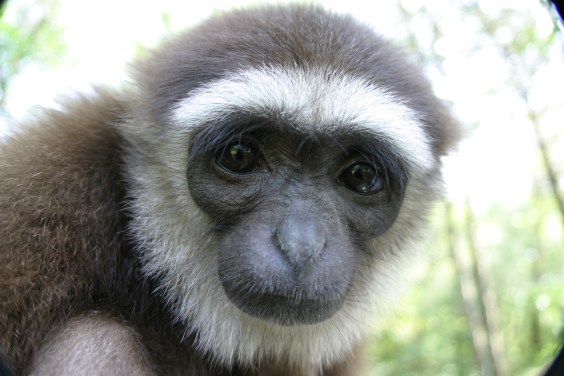
A new study published in the journal *Animal Behavior and Cognition* highlights the cognitive significance of gibbons, a lesser-studied group within the ape family, in understanding the evolutionary origins of human social cognition.
Primatologist Makiko Uchikoshi of Kyoto University, the study’s lead author, emphasized the importance of comparative research across the ape lineage in her statement. "Understanding the evolutionary origins of the human mind requires comparative studies across the ape lineage," she noted. "Despite their evolutionary importance, gibbons remain one of the least studied ape groups in cognitive research."
Gibbons diverged from the human lineage approximately 17 million years ago, earlier than great apes such as chimpanzees and gorillas. They are also unique among apes for their pair-bonded social system, typically living in small groups. These characteristics make them valuable model organisms for studying social cognition—the cognitive processes involved in understanding and interpreting information about others.
To investigate gibbon visual attention patterns, Uchikoshi and her colleagues at Kyoto University conducted an experiment at the Japan Monkey Centre. Three adult gibbons were presented with a monitor displaying photos of humans and other gibbons with neutral expressions. The researchers tracked the gibbons’ eye movements to determine which facial features captured their attention.
The results revealed that, like humans, gibbons focused more on the eyes than on other facial features such as the mouth or nose, regardless of whether the photo depicted a human or another gibbon. Additionally, the gibbons spent more time examining photos of other gibbons compared to photos of humans, suggesting they share key patterns of visual attention with humans and great apes.
The researchers propose that primates, including gibbons and humans, prioritize eye contact because eyes convey critical information about mental states such as interest, desire, rejection, or acceptance. This finding supports the idea that the eyes function as a rich source of social data—a concept often summarized by the phrase "windows to the soul."
While this study represents an initial step toward understanding the evolutionary foundations of social cognition, the researchers aim to build on these findings in future research. Uchikoshi reflected on the significance of the study, stating, "I have known the gibbons that participated in this study for nearly 28 years and have often experienced moments of eye contact, but I had never been able to measure objectively what they were actually looking at. Being able to quantify where they look and for how long felt almost like magic."
The study offers a rare glimpse into the cognitive processes of gibbons, providing insights not only into their behavior but also into the evolutionary roots of human social cognition. By examining these "lesser" relatives, researchers may uncover further clues about the shared origins of primate perception and social understanding.
Comments (0)
No comments yet — be the first to weigh in.

NASA Launches Nancy Grace Roman Telescope to Unlock Universe's Mysteries
NASA's new Nancy Grace Roman Space Telescope lifts off from Florida to study dark energy, exoplanets, and cosmic mysteries with unprecedented precision and scope.

Nature reserves spot rare species during heatwaves
Nature reserves in Hertfordshire and Middlesex have documented rare species this summer, with volunteers spotting wildlife not seen in decades and some even for...

Inmates at HMP La Moye craft boxes to save Jersey's hedgehogs
Prisoners at HMP La Moye have crafted nesting and feeding boxes to support Jersey's hedgehog population, boosting rehabilitation and community engagement.

2026 Nepal Flood: Ice‑Rock Avalanche, Glacial Lake Outburst and Climate‑Change Risks
A massive ice‑rock avalanche triggered a catastrophic flood in Nepal on Aug. 26 2026, followed by a glacial lake outburst that devastated towns and hydropower plants. Climate‑change‑driven thawing increased the risk.

Mumbai’s Vile Parle Cypher is giving unheard rappers a voice

Enrich and Ultimo impress

Karnataka CM Signals Review of 5% Park Land Amendment Bill in Assembly

