QAnon's lingering influence on U.S. politics and culture after decade
A decade after its emergence, QAnon conspiracy theories continue to shape American politics, with echoes in government and pop culture despite the disappearance of its founder 'Q'.
As Election Day 2024 approached, technology entrepreneur and political influencer Elon Musk shared a campaign-style music video supporting former President Donald Trump’s presidential bid. Set to Van Halen’s “Jump,” the video featured 1980s cultural imagery and included a stylized reference to “PATRIOTS,” where the letter “O” transformed into a “Q”—a nod to the QAnon conspiracy theory.
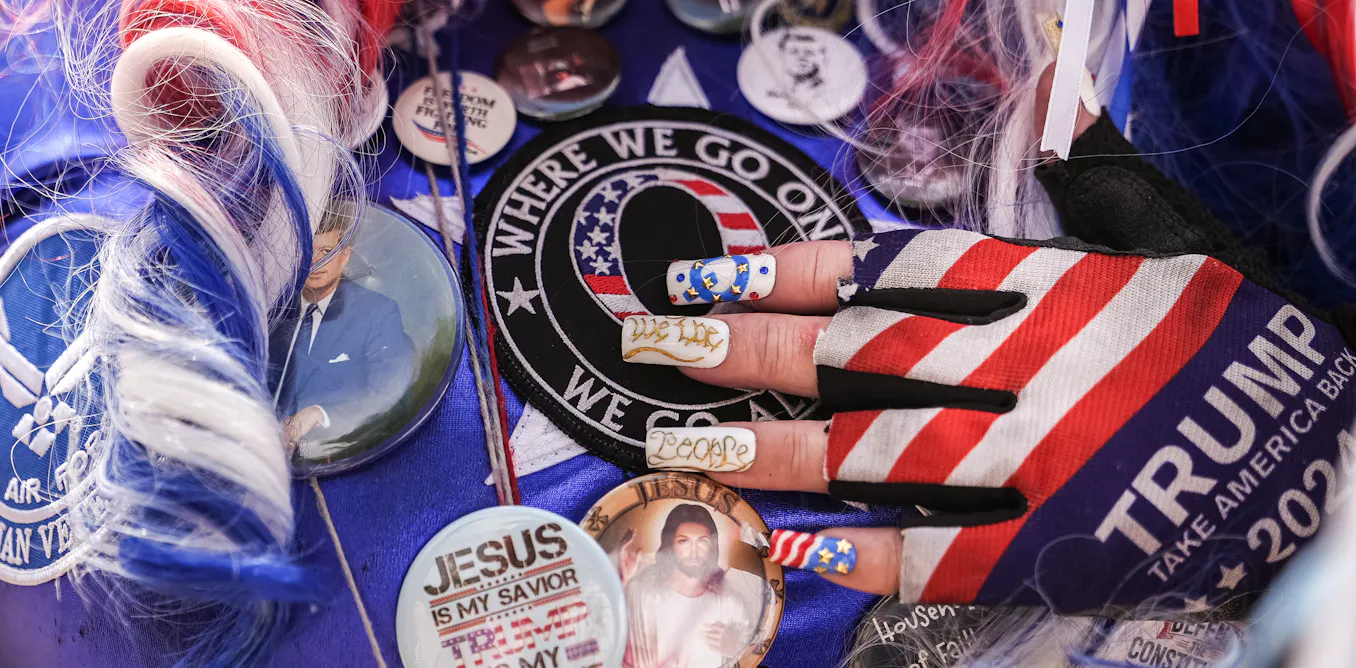
QAnon originated in 2017 on the anonymous online message board 4chan, where a user identifying as “Q” began posting cryptic messages claiming to be an intelligence insider exposing a secretive “deep state.” The theory alleged a global cabal of satanic pedophiles operating within the political elite, supposedly being dismantled by Trump with Q’s guidance. Though Q ceased posting in 2022, the movement’s influence has persisted, embedding itself in American political discourse.
The conspiracy theory emerged from earlier online narratives, including “Pizzagate,” which falsely claimed Democratic officials were involved in child trafficking based on misinterpreted emails. QAnon expanded these ideas into a sprawling, ever-evolving conspiracy that has absorbed unrelated theories, such as claims about 9/11 or the JFK assassination, into a single, overarching narrative. According to public opinion polls, around 20% of Americans expressed favorable views of QAnon as recently as 2022.
The movement’s reach has extended into mainstream politics, with several high-profile figures tied to QAnon ideology gaining influence. Kash Patel, a former Trump administration official nominated to lead the Federal Bureau of Investigation, had previously appeared on a show hosted by a QAnon influencer. Similarly, Robert F. Kennedy Jr., a prominent anti-vaccine advocate, has promoted conspiracy theories aligned with QAnon beliefs.
The lingering presence of QAnon is evident in recent political communications. In 2026, the official X account for the White House shared a post featuring the phrase “Patriots are in Control,” a tagline directly associated with QAnon. The U.S. Department of Labor also used the same phrase over an image of Trump in January 2026, while the department’s head, Lori Chavez-DeRemer, had previously promoted “deep state” conspiracy theories. Similarly, Musk, as head of the Department of Government Efficiency, celebrated America’s 250th anniversary with an AI-generated video titled “Sweet Land,” which contained references to QAnon and sparked an online hunt for hidden Q symbols.
Military and government communications have also incorporated QAnon language. The Pentagon’s chief technology officer, Emil Michael, has posted military slogans using QAnon catchphrases, such as “Trust the Plan.” On Truth Social, Trump shared a meme depicting himself on a battleship with the phrase “It was the Calm Before the Storm,” a phrase first used by Trump in 2017 that later became central to QAnon ideology.
Experts warn that the continued use of QAnon terminology by government accounts, whether intentional or not, reinforces conspiracy narratives online. Supporters interpret these references as confirmation that a major event—“the storm”—is imminent, a period they believe will lead to the downfall of the alleged deep state and the rise of a new political order. Meanwhile, the release of the Jeffrey Epstein files, which revealed details about the late financier’s extensive network and alleged involvement in underage trafficking, has been seized upon by QAnon believers as evidence supporting their claims about elite corruption.
As the United States faces ongoing social and economic challenges, scholars and analysts caution that the persistent influence of QAnon is deepening political divisions and undermining trust in institutions.
#QAnon #ConspiracyTheories #DonaldTrump #ElonMusk #AmericanPolitics #FBI #DeepState #Patriots
Comments (0)
No comments yet — be the first to weigh in.

NASA Launches Nancy Grace Roman Telescope to Unlock Universe's Mysteries
NASA's new Nancy Grace Roman Space Telescope lifts off from Florida to study dark energy, exoplanets, and cosmic mysteries with unprecedented precision and scope.

Nature reserves spot rare species during heatwaves
Nature reserves in Hertfordshire and Middlesex have documented rare species this summer, with volunteers spotting wildlife not seen in decades and some even for...

Inmates at HMP La Moye craft boxes to save Jersey's hedgehogs
Prisoners at HMP La Moye have crafted nesting and feeding boxes to support Jersey's hedgehog population, boosting rehabilitation and community engagement.

2026 Nepal Flood: Ice‑Rock Avalanche, Glacial Lake Outburst and Climate‑Change Risks
A massive ice‑rock avalanche triggered a catastrophic flood in Nepal on Aug. 26 2026, followed by a glacial lake outburst that devastated towns and hydropower plants. Climate‑change‑driven thawing increased the risk.

Mumbai’s Vile Parle Cypher is giving unheard rappers a voice

Enrich and Ultimo impress

Karnataka CM Signals Review of 5% Park Land Amendment Bill in Assembly

