















































Canada Federal Election Called for April 28 as Liberals Trail Conservatives by 12 Points
Canadian Prime Minister Mark Carney called a federal election for April 28 2026 on Wednesday launching a campaign in which the Liberal Party trails the Conservative Party by 12 percentage points in the latest national polling amid voter anger over cost of living and housing affordability.
- Canadian Prime Minister Mark Carney called a federal election for April 28 2026 on Wednesday launching a campaign in which the Liberal Party trails the Conservative Party by 12 percentage points in the latest national polling amid voter anger over cost of living and housing affordability.
- Category: Canada
- Published: Feb 26, 2026
Canada Heads to the Polls April 28 as Liberals Face Uphill Battle Against Surging Conservatives
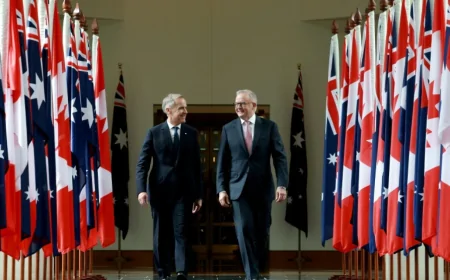
Mark Carney made it official on Wednesday morning. Canada's Prime Minister visited Governor General Mary Simon at Rideau Hall and requested the dissolution of Parliament, triggering a federal election campaign with voting day set for April 28, 2026. The writ dropped at 10:15 a.m. Eastern time, and the campaign — expected to be one of the most consequential in a generation — began immediately.
The political landscape Carney is entering is difficult. The latest Leger poll, conducted February 22 to 24 and released Tuesday, shows the Conservative Party of Canada under Pierre Poilievre at 43 percent support nationally, with the Liberals at 31 percent. The NDP sits at 16 percent. The 12-point Conservative lead is within the range that, if maintained on election day, would likely produce a majority Conservative government — the first since Stephen Harper's 2011 victory.
The Issues Driving the Campaign and Carney's Case to Voters
Cost of living is the dominant issue by a significant margin. Seventy-one percent of Canadians in the Leger poll named affordability — housing prices, grocery costs, and energy bills — as their primary concern. Housing in particular has become a flashpoint: the average home price in Canada reached $847,000 in January 2026, the highest ever recorded, with Toronto and Vancouver markets averaging well above $1 million.
Carney, who took over as Liberal leader and Prime Minister from Justin Trudeau in January, is attempting to reframe the Liberal brand around economic competence — leaning on his background as former Governor of the Bank of Canada and the Bank of England. He has proposed a $40 billion national housing construction fund, an expanded carbon rebate, and a new Canada-U.S. trade diversification strategy in response to Trump's tariffs.
According to Dr. Shachi Kurl, president of the Angus Reid Institute, Carney is essentially asking Canadians to evaluate him as a new leader rather than punishing him for a decade of Liberal government. That is a difficult ask. Voters who want change tend not to make fine distinctions between a party's new leader and its old record.
Poilievre's Conservative Campaign and the Path to a Majority
Pierre Poilievre has built his campaign around three words that have become his political brand: axe the tax. His signature promise is the elimination of Canada's carbon pricing mechanism, which the Conservatives argue increases costs for ordinary Canadians without meaningfully reducing emissions. He has also promised to cut federal spending by an unspecified amount, defund CBC English television, and pursue a harder line on crime and immigration.
The Conservatives are particularly strong in Ontario's suburban 905 region, the Prairie provinces, and rural British Columbia — a coalition that, if it holds, produces a majority. Their vulnerability is in urban Quebec, where the Bloc Québécois remains competitive, and in Atlantic Canada, where Liberal loyalty has historically run deep.
The NDP's Jagmeet Singh is fighting to maintain relevance in a campaign that is shaping up as a two-party contest. The party's supply and confidence agreement with the Liberals formally ended last year, and Singh is now positioning the NDP as the only party that will stand up for workers against both Liberal and Conservative corporate priorities.
With 61 days of campaigning ahead and U.S. trade tensions, cost of living pressures, and housing affordability all on the table, the April 28 vote is shaping up as one of the most consequential Canadian federal elections in memory — and the outcome is far from certain.