






































Alphabet Plans $80 Billion AI Fundraising with $10 Billion Berkshire Investment
Alphabet announced plans on June 2, 2026, to raise $80 billion for AI infrastructure expansion, including a $10 billion investment from Berkshire Hathaway.
- Alphabet announced plans on June 2, 2026, to raise $80 billion for AI infrastructure expansion, including a $10 billion investment from Berkshire Hathaway.
- Category: Business
- Published: Jun 2, 2026
Alphabet Plans $80 Billion AI Fundraising with $10 Billion Berkshire Investment
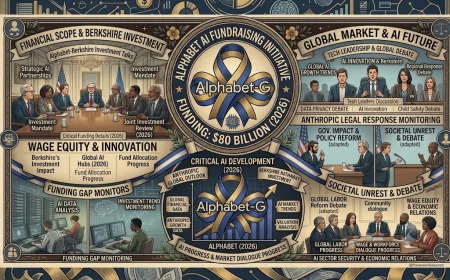
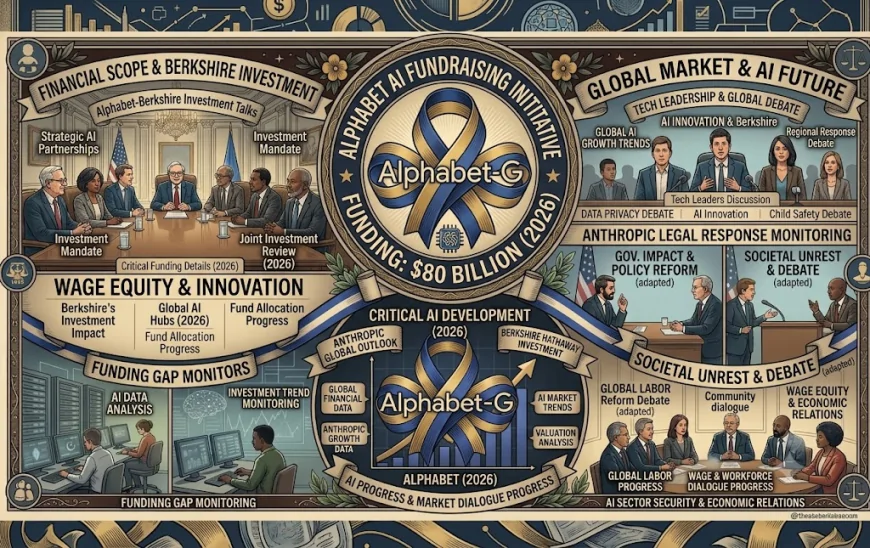
Alphabet announced on June 2, 2026, that it plans to raise $80 billion through equity offerings to fund an aggressive expansion of its artificial intelligence infrastructure. The Google parent company revealed that Berkshire Hathaway, Warren Buffett's conglomerate, will invest $10 billion as part of the fundraising effort. The announcement signals one of the largest capital-raising campaigns in corporate history and underscores the staggering costs of building next-generation AI capabilities.
The funds will be directed toward expanding Alphabet's data center footprint, developing custom AI chips, and training large language models that compete with OpenAI's GPT series. Alphabet has been locked in an arms race with Microsoft, Amazon, and Meta to dominate the generative AI market. The company's capital expenditure on AI infrastructure reached $32 billion in 2025, and the new fundraising suggests that figure could double by 2027. According to Sundar Pichai, Alphabet's CEO, "The demand for AI compute is growing exponentially. We are investing to meet that demand and to maintain our leadership position."
Berkshire Hathaway's involvement is particularly notable. Warren Buffett has historically been skeptical of technology investments, avoiding major bets on the sector until his 2016 purchase of Apple shares. The $10 billion Alphabet commitment represents Berkshire's largest technology investment since that Apple purchase. Buffett has recently warmed to AI, acknowledging in his 2025 annual letter that the technology could "transform every industry we invest in." The investment also provides Alphabet with a stamp of credibility from one of the world's most respected investors.
Market Reaction and Competitive Landscape
Alphabet's shares rose 3.4% in after-hours trading following the announcement. Analysts at Morgan Stanley raised their price target for the stock to $220, citing the Berkshire investment as a validation of Alphabet's AI strategy. The fundraising comes at a critical moment. Alphabet's cloud computing division, Google Cloud, has been losing market share to Amazon Web Services and Microsoft Azure. AI services represent the company's best opportunity to close that gap. Google Cloud revenue grew 28% in the first quarter of 2026, but it remains a distant third in the market.
The competitive pressure is intense. Microsoft has invested $13 billion in OpenAI and is integrating GPT technology across its Office and Azure products. Amazon has committed $15 billion to its own AI initiatives, including the development of the Trainium chip. Meta has spent $18 billion on AI infrastructure in 2025 alone. According to a 2026 report from Gartner, global spending on AI infrastructure will reach $200 billion this year, up from $120 billion in 2025. The market is expanding rapidly, but so are the costs of participation.
Some investors have expressed concern about the scale of Alphabet's spending. The $80 billion fundraising will dilute existing shareholders and increase the company's debt load. Alphabet already carries $28 billion in long-term debt, a significant increase from its historically conservative balance sheet. According to Dr. Aswath Damodaran, a professor of finance at NYU Stern School of Business, "This is a bet-the-company moment. If Alphabet's AI investments don't generate returns, the shareholders will pay a heavy price." The risk is real, but so is the opportunity.
Background & Context
Alphabet's AI push has accelerated dramatically since the launch of ChatGPT in late 2022. Google's own chatbot, Bard, was released in 2023 but struggled to gain traction against OpenAI's more advanced offering. The company reorganized its AI teams in 2024, merging Google Brain and DeepMind into a single unit called Google DeepMind. Under the leadership of Demis Hassabis, the combined unit has produced several breakthroughs, including the AlphaFold protein structure prediction system and the Gemini multimodal AI model.
The $80 billion fundraising also reflects a broader shift in how tech companies finance AI development. Rather than funding expansion through operating cash flow, companies are increasingly turning to external capital markets. According to data from PitchBook, AI-related equity offerings reached $45 billion in 2025, up from $12 billion in 2023. The trend suggests that investors are willing to pour money into AI infrastructure despite uncertain returns. Berkshire Hathaway's participation in the Alphabet offering may encourage other institutional investors to follow suit.
Frequently Asked Questions
What happened?
Alphabet announced on June 2, 2026, plans to raise $80 billion for AI infrastructure, with Berkshire Hathaway committing $10 billion.
Why does this matter?
The fundraising is one of the largest in corporate history and signals that AI infrastructure competition is entering a capital-intensive phase.
Who is affected?
Alphabet shareholders, Berkshire Hathaway investors, rival AI companies like Microsoft and Amazon, and the broader tech sector all face implications.
What happens next?
Alphabet will likely file the equity offering within weeks, with the first tranche targeting $30 billion to fund immediate data center expansion.