


















































Race Against Time to Rescue Two Men Trapped in Laos Cave
Rescue teams are racing against time to find and rescue two men trapped in a flooded cave in Laos, with heavy rains complicating the dangerous operation.
- Rescue teams are racing against time to find and rescue two men trapped in a flooded cave in Laos, with heavy rains complicating the dangerous operation.
- Category: South Asia
- Published: Jun 2, 2026
Race Against Time to Rescue Two Men Trapped in Laos Cave
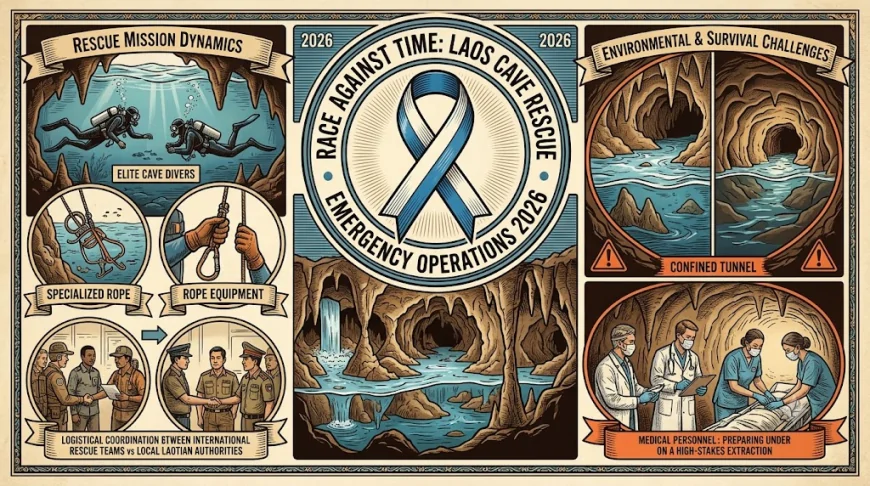
Rescue teams are racing against time to locate and extract two men trapped in a flooded cave system in northern Laos, officials confirmed on June 2, 2026. The men, believed to be local miners, entered the cave several days ago and have not been seen since heavy rains caused flash flooding that blocked the entrance. The rescue operation, which involves international cave diving specialists and local emergency teams, has been hampered by continued rainfall and the complex geography of the cave system. The situation evokes memories of the 2018 Tham Luang rescue in Thailand, where 12 boys and their coach were trapped for 17 days.
The cave, located in Luang Prabang Province, is part of a vast network of limestone caverns that crisscross the region. Local residents reported hearing cries for help from deep inside the cave on June 1, but subsequent attempts to reach the men have been thwarted by rising water levels. The Lao government has requested assistance from neighboring Thailand, which has sent a team of experienced cave divers who participated in the Tham Luang rescue. The British Cave Rescue Council has also offered support, and a team is expected to arrive within 48 hours.
The trapped men are believed to have entered the cave to collect bat guano, a valuable fertilizer that is harvested commercially in the region. This dangerous practice involves crawling deep into cave systems with minimal equipment and no communication devices. When flash floods struck, the men had no warning and no escape route. According to Lao Ministry of Public Security officials, the men may have found an air pocket above the water line, but their exact location and condition remain unknown. Time is critical, as oxygen levels in confined cave spaces can deplete rapidly.
Rescue Challenges and International Cooperation
The rescue operation faces formidable obstacles. The cave system is largely unmapped, with narrow passages, underwater sections, and unstable rock formations. Continued monsoon rains are raising water levels faster than pumps can remove the water. The nearest cave diving specialists are in Thailand, and transporting their equipment to the remote Lao site is a logistical challenge. According to Ben Reymenants, a Belgian cave diver who participated in the Tham Luang rescue, "Every cave is different, but the principles are the same. We need to establish a supply line, map the flooded sections, and find a way to reach the survivors. The first 72 hours are critical."
The Lao government has been criticized for its slow response to the crisis. Initial rescue efforts were led by local volunteers with limited equipment and training. It took nearly 24 hours for provincial authorities to request national-level support, and another 24 hours for international assistance to be coordinated. The delays have frustrated families of the trapped men, who have gathered at the cave entrance demanding faster action. Social media posts from the scene show desperate relatives pleading with officials to do more.
International attention has grown as news of the rescue spreads. The European Union has offered technical assistance and equipment. The United States, which has limited diplomatic presence in Laos, has offered satellite imagery to help map the cave system. China, which has significant infrastructure investments in Laos, has sent a team of engineers to assess whether drilling operations could create an alternative access point. The multinational response highlights both the humanitarian stakes and the geopolitical competition for influence in Southeast Asia.
Background & Context
Cave rescue operations in Southeast Asia have become more frequent as commercial activities push deeper into remote cave systems. The 2018 Tham Luang rescue, which captivated the world and was later dramatized in several films, demonstrated both the possibilities and the perils of such operations. That rescue involved over 10,000 people, including 100 divers, and resulted in the death of one Thai Navy SEAL. The estimated cost exceeded $1 million, funded by international donations and the Thai government. The current Laos operation is smaller in scale but equally desperate.
Laos has limited experience with large-scale cave rescues. The country's emergency response infrastructure is underdeveloped, with few specialized rescue teams and limited equipment. According to a 2024 report from the Asian Disaster Preparedness Center, Laos ranks among the lowest in Southeast Asia for disaster response capacity. The current crisis may prompt the government to invest in better training and equipment, but such improvements will come too late for the two men currently trapped. The outcome of this rescue will likely influence policy for years to come.
Frequently Asked Questions
What happened?
Two men are trapped in a flooded cave in northern Laos, and rescue teams are racing to reach them before oxygen or water levels become fatal.
Why does this matter?
The rescue tests international cooperation in Southeast Asia and highlights the dangers of unregulated cave harvesting in monsoon-prone regions.
Who is affected?
The trapped men and their families, Lao rescue teams, international cave divers, and communities dependent on cave harvesting for income.
What happens next?
Thai and British cave diving teams will attempt to establish a supply line and locate the men, while engineers assess drilling options for alternative access.