



















Philippines Vietnam Upgrade to Enhanced Strategic Partnership
The Philippines and Vietnam forged an enhanced strategic partnership on June 2, creating new defence and maritime coordination frameworks for South China Sea.
- The Philippines and Vietnam forged an enhanced strategic partnership on June 2, creating new defence and maritime coordination frameworks for South China Sea.
- Category: South Asia
- Published: Jun 2, 2026
Philippines and Vietnam Forge Enhanced Strategic Partnership Amid South China Sea Tensions
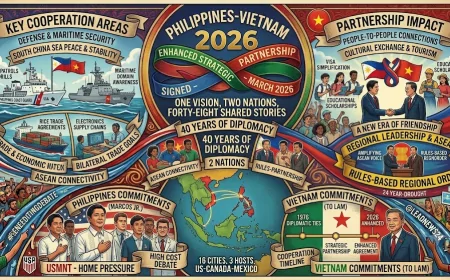
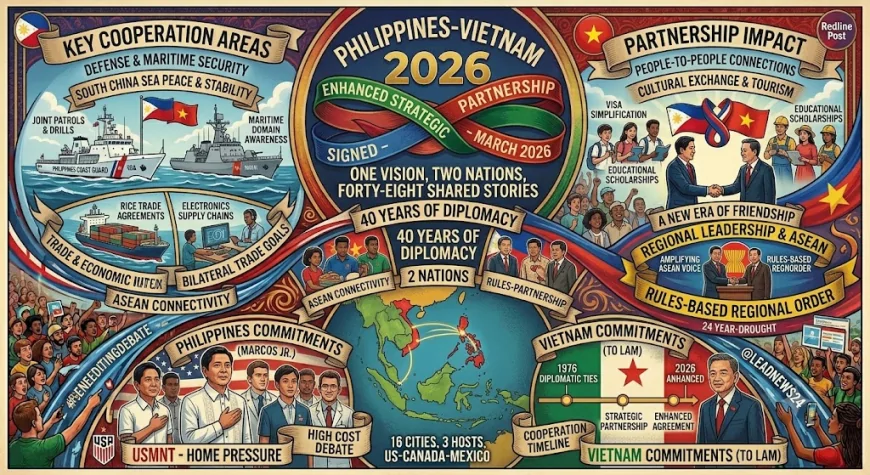
The Philippines and Vietnam upgraded their bilateral relationship to an enhanced strategic partnership on June 2 during Vietnamese President Tô Lâm's state visit to Manila — a diplomatic step that carries significant implications for how Southeast Asian nations are coordinating their responses to China's continued assertiveness in the South China Sea. Philippine President Ferdinand Marcos Jr. and President Tô Lâm signed a joint declaration formalising the enhanced partnership, which elevates the relationship from a comprehensive partnership established in 2015 and creates new frameworks for defence, maritime security, and economic cooperation.
Both Vietnam and the Philippines are among the most directly affected claimants in the South China Sea disputes, which involve competing territorial claims across the Spratly Islands, Paracel Islands, and Scarborough Shoal. China claims approximately 90% of the South China Sea under its nine-dash line assertion, a claim that a 2016 international arbitration tribunal ruled had no basis in international law. China rejected that ruling and has continued expanding its artificial island installations and asserting control over disputed maritime features.
The timing of the enhanced partnership is not coincidental. Both countries have experienced escalating encounters with Chinese Coast Guard and maritime militia vessels in 2025 and 2026, including water cannon attacks, laser targeting, and physical obstruction of resupply missions to Philippine-occupied features. A coordinated approach between Manila and Hanoi strengthens both countries' diplomatic hand in multilateral forums.
Defence and Maritime Security Dimensions
The enhanced strategic partnership includes commitments to expand joint naval exercises, share maritime domain awareness data, and coordinate positions in multilateral forums including ASEAN and the United Nations Law of the Sea framework. The Philippines and Vietnam had previously conducted limited bilateral naval exercises, but the new framework establishes a regularised schedule and a joint operational coordination mechanism.
The Philippines has been developing its defence posture rapidly since President Marcos took office in 2022, rebuilding the US alliance relationship that deteriorated under Rodrigo Duterte and investing in new maritime patrol vessels, radar systems, and coastal defence missiles. Vietnam maintains a different strategic approach — hedging between China, the US, and Russia — but the two countries' shared South China Sea concerns provide a convergence point despite their different overall alignments.
According to Dr. Collin Koh, research fellow at the S. Rajaratnam School of International Studies in Singapore, "This is part of a broader pattern in which Southeast Asian claimant states are quietly building coordination mechanisms with each other, supplementing rather than replacing their individual relationships with major powers. The Philippines-Vietnam enhanced partnership is one of the more significant of these lateral linkages because both countries are directly involved in active flashpoints." The Philippines experienced over 60 documented incidents involving Chinese maritime forces in the South China Sea in 2025, the highest annual total on record and a significant escalation from previous years.
Economic and Trade Dimensions
Beyond defence and maritime security, the enhanced partnership includes commitments to expand bilateral trade, which reached $8.3 billion in 2025. Both countries are members of ASEAN and the Regional Comprehensive Economic Partnership, providing an existing institutional framework for trade facilitation. The partnership adds dedicated working groups on agricultural trade, digital economy cooperation, and green energy investment.
Vietnam is one of the world's largest rice exporters, while the Philippines is a major rice importer — creating a natural complementarity that both governments have agreed to formalise through long-term supply agreements that reduce the Philippines' exposure to global rice price volatility. The two countries also share interests in expanding their semiconductor supply chain roles, with both hosting major electronics manufacturing operations and seeking to move up the value chain.
President Marcos described the partnership as "a relationship built on mutual respect, shared values, and the conviction that a rules-based regional order benefits both our nations." The phrase "rules-based order" is a direct reference to the international law framework that both countries invoke in challenging China's South China Sea claims.
Background and Context
Vietnam and the Philippines normalised relations in 1976 following years of Cold War-era distance. Their relationship has historically been warm but not particularly close, with both countries maintaining more intensive bilateral relationships with their major power partners — the US for the Philippines, and a more diversified set including Russia and China for Vietnam. The South China Sea disputes have gradually drawn them into more regular consultation over the past decade.
According to the ASEAN Outlook on the Indo-Pacific, adopted in 2019, Southeast Asian nations prefer a regional approach to managing great power competition rather than choosing sides. The Philippines-Vietnam enhanced partnership is consistent with that framework — it does not explicitly target China, does not involve mutual defence commitments, and is framed in terms of shared international law principles rather than alliance politics. That framing is important both domestically for each government and for managing the relationship with Beijing, which closely monitors ASEAN bilateral partnerships for signs of coordinated containment.
Whether this enhanced partnership translates into meaningful operational coordination in South China Sea incidents — the real test of its value — will become clear only when the next significant confrontation occurs, and both governments must decide whether to respond individually or in consultation with each other.
Frequently Asked Questions
What happened?
The Philippines and Vietnam upgraded to an enhanced strategic partnership on June 2 during Vietnamese President Tô Lâm's state visit to Manila, creating new frameworks for defence cooperation, maritime security coordination, and economic partnerships including rice supply agreements.
Why does this matter?
The partnership strengthens coordination between two of the most directly affected South China Sea claimants. It signals a broader trend of Southeast Asian nations building lateral relationships to supplement their individual major power alignments in managing regional security challenges.
Who is affected?
The Philippines and Vietnam's 175 million combined citizens, regional security dynamics in the South China Sea, ASEAN's institutional coherence, China's maritime strategy calculations, and US Indo-Pacific alliance management are all affected by this diplomatic development.
What happens next?
Joint naval exercise schedules will be formalised within weeks. Maritime domain awareness data-sharing protocols will be established through military-to-military channels. The rice supply agreement framework will move to technical negotiation. The real test comes at the next significant South China Sea incident involving either country.