


















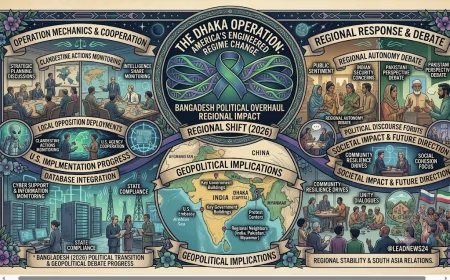









THE DHAKA OPERATION: How America Engineered a Regime Change — And Why Its Next Move Could Ignite South Asia
Did the U.S. orchestrate Sheikh Hasina's fall? From USAID-funded rap videos to Yunus's Clinton ties — an explosive investigation into Bangladesh's regime change.
- Did the U.S. orchestrate Sheikh Hasina's fall? From USAID-funded rap videos to Yunus's Clinton ties — an explosive investigation into Bangladesh's regime change.
- Category: Editor's Choice
- Published: Mar 8, 2026
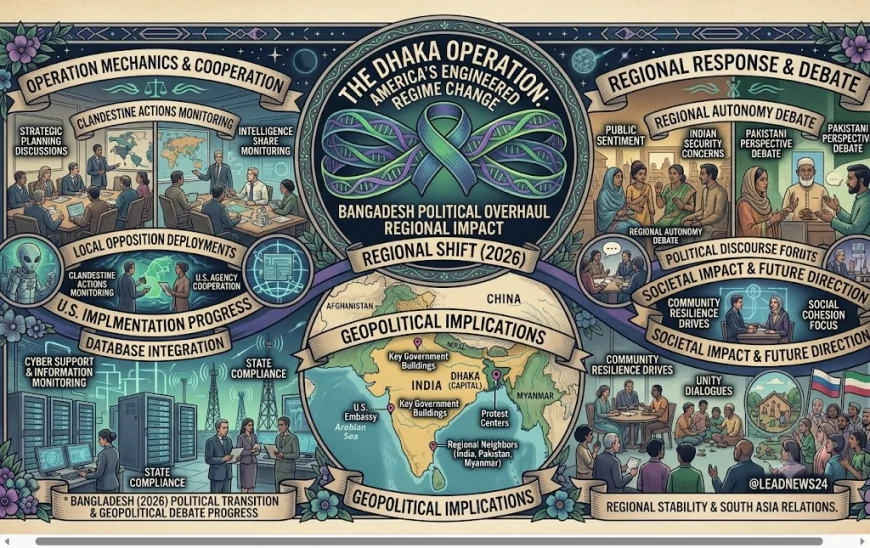
An Investigative Report
By Sheikh Sadeque Ali
"A white man came to me before the January 2024 election and said there would be no problems if I allowed a foreign nation to establish an airbase on Bangladeshi soil. I refused. And then the trouble began." — Sheikh Hasina, former Prime Minister of Bangladesh
PROLOGUE: The Island at the Center of Everything
It is barely 8 square kilometers. A coral sliver in the Bay of Bengal, battered by monsoons, home to a few thousand fishermen. But Saint Martin's Island — sitting at the maritime gateway between South and Southeast Asia, with sightlines across the Strait of Malacca shipping corridor — may be the most strategically coveted piece of real estate that most people have never heard of.
It is, intelligence analysts say, the kind of location that empires have always killed for.
And according to a cascade of allegations now spilling from governments, leaked documents, former officials, and declassified research — the United States may have done precisely that. Not with bombs, but with something more sophisticated: money, NGOs, music videos, student protests, and a Nobel laureate with deep ties to the Clinton machine.
What happened in Bangladesh in August 2024 deserves far more scrutiny than it has received. This is that scrutiny.
PART ONE: THE PRIZE — What America Actually Wants
To understand the events of 2024, you must first understand what Bangladesh represents on a geopolitical chessboard.
The country sits at the northeastern tip of the Bay of Bengal — a body of water through which an estimated $5 trillion in global trade passes annually. It borders Myanmar to the east, India on three sides, and faces directly onto sea lanes connecting the Indian Ocean to the South China Sea. Whoever commands maritime presence here commands an extraordinary chokepoint in the Indo-Pacific.
The U.S. Indo-Pacific Strategy, formalized under both the Biden and Trump administrations, identifies the Bay of Bengal as a critical theater in its effort to contain Chinese naval expansion. For Washington, a friendly Bangladesh — or better still, a Bangladesh with a U.S. military or intelligence footprint — would be an asset of enormous value.
Saint Martin's Island is the jewel of that strategic logic. Persistent reports indicate that U.S. officials offered Sheikh Hasina a trouble-free election in January 2024 in exchange for allowing a foreign power to set up an airbase on Bangladeshi territory. OpIndia She refused. Within months, she was gone.
But the island is only part of the picture. The U.S. has also shown considerable interest in the Matarbari Deep-Sea Port in Cox's Bazar — a Japan-backed project that could provide strategic naval logistics capability — and in Bangladesh's wider naval infrastructure, which Washington sees as a potential platform for monitoring China's ambitions via the China-Myanmar Economic Corridor (CMEC).
Then there is the energy dimension. Chevron, a U.S. corporation, produces roughly 50% of Bangladesh's domestic natural gas. This is not development aid. It is structural dependency, dressed in the language of investment. Past contracts signed under military rule in the 1980s reportedly lacked environmental liability clauses — meaning American companies could extract and damage with impunity.
The United States also remains Bangladesh's single largest export market, absorbing the bulk of its $40+ billion garment industry. This creates leverage that needs no army to enforce.
PART TWO: THE OPERATION — Six Years in the Making
Nowhere in South Asia has U.S. intervention been more consequential than in Bangladesh. The Tribune And the paper trail, now partially exposed by the defunding of USAID under the Trump administration, is damning.
The story begins in 2018, when Sheikh Hasina won her fourth consecutive election. Washington was displeased. Dissatisfaction within the U.S. State Department over the 2018 Bangladesh election outcome prompted officials to consult USAID and the NED-funded International Republican Institute (IRI) on strategies to destabilise her government. Considering her party's wide popular mandate, fomenting political unrest was seen as the only viable route to achieving regime change. ORF Online
What followed was not improvised. It was programmatic.
This led to the creation of PAIRS — a programme called 'Promoting Accountability, Inclusivity and Resiliency Support Program, Bangladesh' — which ran between March 2019 and December 2020, and which arguably set in motion a series of events that culminated in Hasina's ouster. ORF Online
The mechanics of the operation were disturbingly mundane. Lawyer and rapper Towfique Ahmed was awarded advocacy grants for the production of two music videos — rallying cries for urban youth disillusioned with the government, including direct calls to street protests. As part of efforts to engage the LGBTQI+ community in effecting political change, transgender dance troupes were also given grants to stage performances in urban centres, symbolising defiance. ORF Online
The IRI reportedly awarded advocacy grants to 11 artists, musicians, and performers, resulting in over 225 pieces of content designed to build what the program called "disappointment and dissent" toward the sitting government. Student political participants were trained. Civil society organizations received "capacity-building" funding. Tens of thousands of mainstream politicians were coached. The groundwork was being laid — methodically, invisibly, over years.
Then came the trigger.
In the summer of 2024, protests erupted over a government quota reserving 30% of civil service jobs for descendants of 1971 liberation war veterans. The Supreme Court ruled to reduce the quota to 5%. This ought to have resolved the issue, but instead protests against Hasina only increased as students were swiftly co-opted by the political opposition. The Tribune
In May 2024, U.S. officials visited Dhaka to discuss the Indo-Pacific Strategy. Within weeks, protests that had begun over civil service job quotas transformed into a broader movement demanding Hasina's resignation. By August 5, she had fled the country. Peoples Dispatch
The speed of what followed tells its own story. The speed with which the United States embraced the interim government under Muhammad Yunus — including a $202 million USAID package and President Biden's meeting with Yunus at the UN General Assembly in September — indicates a level of prior coordination that demands scrutiny. Peoples Dispatch
Between 2020 and 2024, Bangladesh received $2.29 billion in aid, of which $1.73 billion came from USAID. Within days of the interim government assuming office, USAID signed a $200 million deal with it for governance and trade expansion. The Tribune
The money was ready. The government was ready. The only thing that needed to happen was the fall.
PART THREE: THE MAN — Yunus, the Clintons, and the Long Game
Muhammad Yunus did not emerge from obscurity. He was cultivated.
The Nobel laureate's relationship with the Clinton family stretches back decades — to the time when Bill Clinton was still Governor of Arkansas. Over the years, the relationship blossomed under an extremely lucrative dynamic: the Clintons paraded Yunus as the pinnacle of moral and philanthropic excellence, while Yunus funnelled between $125,000 and $300,000 back to the Clinton Global Initiative. CFACT
The returns for Yunus were substantial. Hillary Clinton, as Secretary of State, appears to have used her position to advocate for $164.2 million of USAID taxpayer funds being directed to Yunus's enterprises. CFACT When Yunus fell out with Hasina's government in 2011 over his conduct at Grameen Bank, he called Hillary for help, and she sent her aides scurrying to find ways to support him. CFACT
In 2016, Yunus donated $300,000 to the Clinton Foundation. OpIndia
In September 2024, weeks after becoming head of Bangladesh's interim government, Yunus attended the Clinton Global Initiative — and boasted that the seemingly spontaneous "revolution" that toppled Hasina had actually been "meticulously designed." The Gateway Pundit
The connections extend beyond Yunus himself. His new foreign minister, Touhid Hossain, had in 2021 served as a featured guest presenter at a USAID workshop training Bangladeshi reporters on "countering misinformation." The Gateway Pundit
This is not coincidence. This is infrastructure.
Hasina's former minister, Mohibul Hasan Chowdhury, stated plainly: "This relationship reflects a deeper attempt by the Clinton Foundation and Yunus to push for regime change under the guise of democracy and development." The Week He also revealed a geopolitical dimension that has received almost no coverage in Western media: Bangladesh's refusal to condemn Russia at the United Nations over the Ukraine invasion. While other countries in South Asia were following Western dictates, Bangladesh chose to abstain from voting The Week — an act of independent foreign policy that Washington apparently could not tolerate.
PART FOUR: THE GEOGRAPHY — China, Myanmar, and the Trap America Cannot Spring
Here is where Washington's strategy collides with irreversible geographic reality.
China is not a visitor to Bangladesh. It is embedded. The Belt and Road Initiative has financed the Padma Rail Link, the Karnaphuli Tunnel, power plants, and economic zones. Bilateral trade exceeds $25 billion annually. China is Bangladesh's largest source of imports by a significant margin.
More critically: China does not need Bangladesh's permission to maintain strategic relevance in the region. The Shwe natural gas field off Myanmar's Arakan coast — operated under Chinese control — sits within striking proximity to Bangladesh's southeastern maritime boundary. The China-Myanmar Economic Corridor gives Beijing a direct overland route toward the Bay of Bengal. And Myanmar's ongoing civil war has, if anything, deepened Chinese entrenchment in the country's resource-rich western regions.
Any attempt to tilt Bangladesh sharply away from China would not simply be resisted diplomatically. It would invite a Chinese strategic response that the United States — operating thousands of miles away — is poorly positioned to counter. The geography does not favor Washington's gambit.
There is also the matter of what destabilization actually produces. The interim government's lifting of the ban on Jamaat-e-Islami — a party whose leaders were convicted of genocide during the 1971 war — has enabled its re-entry into political life. According to the Bangladesh Hindu Buddhist Christian Unity Council, over 2,000 incidents of communal violence occurred in the weeks following Hasina's ouster, including attacks on temples and destruction of Hindu-owned properties. Peoples Dispatch
America sought a compliant strategic partner. What it has produced, at least in part, is a Bangladesh more vulnerable to religious extremism, more economically unstable, and more isolated from the regional relationships — particularly with India — that provided ballast for decades.
This is not a victory. It is blowback in slow motion.
PART FIVE: THE RECKONING — What Happens If Washington Pushes Further
The current government, led by the BNP under Prime Minister Tarique Rahman, and with U.S. Ambassador Brent T. Christensen as Washington's point man in Dhaka, is navigating a minefield. Frequent high-level meetings between Bangladeshi officials and the U.S. Embassy — on trade, defense cooperation, Indo-Pacific strategy — raise pointed questions about the degree of sovereignty Bangladesh is actually exercising.
The pressure to join the Quad — the U.S.-Japan-Australia-India security grouping — remains live. So does the push to sign defense pacts including GSOMIA (General Security of Military Information Agreement) and ACSA (Acquisition and Cross-Servicing Agreement), which critics argue would place Bangladesh's military infrastructure under de facto American operational influence.
And Saint Martin's Island has not gone away as a subject of strategic desire. It will not.
But here is the calculation that Washington appears to be getting dangerously wrong. Bangladesh is not a small island nation with no leverage and no alternatives. It is a country of over 170 million people — a young, increasingly connected population with a fierce national consciousness forged in the bloodiest liberation struggle of the 20th century's final decades. It has survived Pakistani genocide in 1971. It will not quietly submit to a 21st century version of subordination.
If Washington squeezes too hard — through tariff pressure (the Trump administration imposed a 37% tariff on Bangladesh in April 2025, later reduced to 20%), through continued interference in its political architecture, through demands for strategic concessions — it will not produce alignment. It will produce the opposite: a Bangladesh that looks east, not west, and does so with grievance rather than goodwill.
China is patient. It is already there. It can wait.
Russia's Foreign Ministry spokeswoman Maria Zakharova predicted in December 2023, with eerie precision, exactly what would happen if Hasina won the January 2024 election — naming the tactics Washington would use to remove her. She was right on every count. That should alarm anyone who believes American intentions in South Asia are purely benign.
EPILOGUE: The Warning in Plain Sight
The United States has a long history of installing compliant governments in countries of strategic value — and an equally long history of being surprised by the chaos that follows. Vietnam. Iran. Iraq. Libya. Afghanistan. The pattern is consistent: an overestimation of American leverage, an underestimation of local nationalism, and an aftermath that serves neither American interests nor the people of the country in question.
Bangladesh is not a domino. It is not a base. It is not a buffer. It is a sovereign nation of immense complexity, sitting at the intersection of the most consequential geopolitical competition of our era.
The lemon, as any cook knows, must be handled with care. Squeeze it too hard, and you get nothing of use — only bitterness, and a hand stained with something you cannot easily wash off.
Washington would do well to remember that. The evidence suggests, so far, it has not.
This investigative report draws on research from the Observer Research Foundation, The Tribune India, The Grayzone, The Diplomat, People's Dispatch, and multiple primary source statements. All allegations against U.S. agencies have been denied by Washington. Readers are encouraged to weigh the evidence and reach their own conclusions.