


























Malaysia Bans Social Media for Under-16s in Southeast Asia First
Malaysia enforced its social media ban for under-16s on June 1, requiring age verification from all platforms with over 8 million Malaysian users.
- Malaysia enforced its social media ban for under-16s on June 1, requiring age verification from all platforms with over 8 million Malaysian users.
- Category: Technology
- Published: Jun 2, 2026
Malaysia's Social Media Ban for Children Under 16 Takes Effect
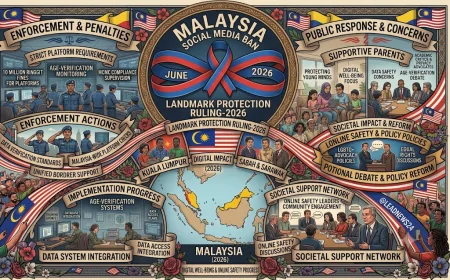
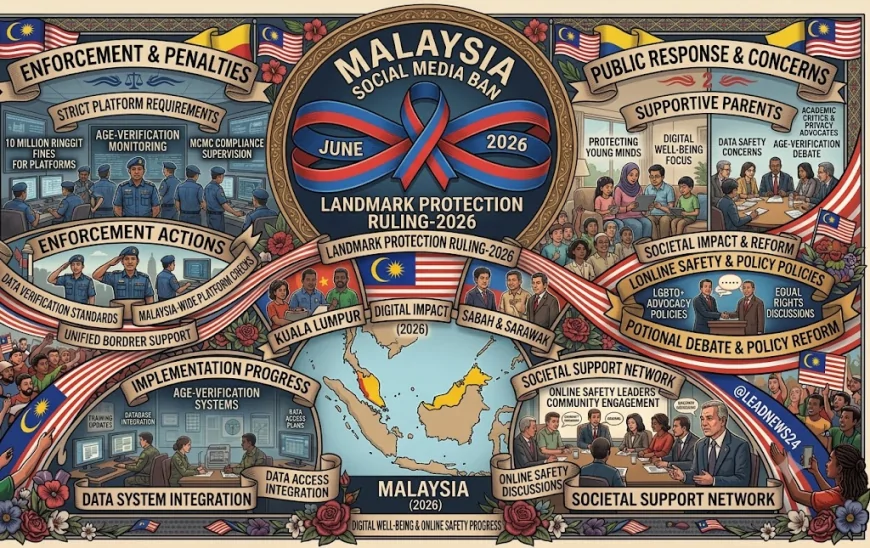
Malaysia formally enforced its ban on social media accounts for children under the age of 16 on June 1, 2026, becoming the latest country to act on growing international consensus that unrestricted social media access poses measurable harms to child wellbeing. The requirement, established under Malaysia's Online Safety Act, applies to all social media platforms with more than eight million users in the country — a threshold that captures Facebook, Instagram, TikTok, YouTube, X, Snapchat, and Threads.
Platforms that fail to comply face civil penalties of up to 10 million ringgit, equivalent to approximately $2.5 million USD. The Malaysian Communications and Multimedia Commission confirmed that companies will be given a grace period to implement technical age verification measures before penalties begin accruing, though the regulator declined to specify the length of that grace period.
Malaysia is not acting in isolation. Australia implemented a similar ban in late 2025. France, Spain, Italy, Denmark, and Greece are jointly developing a shared age verification application. Norway has proposed a minimum age of 15. The global wave of child social media regulation represents a significant shift in the political economy of platform governance — from voluntary age self-declaration to mandatory technical verification.
How Age Verification Will Work
The Malaysian approach involves electronic know-your-customer checks using official identity documents. Users attempting to register on covered platforms will need to verify their age using Malaysia's MyKad national identity card, passport, or the government's MyDigital ID system. The MCMC has acknowledged that privacy protection in the verification process is a critical technical and legal challenge.
Critics argue the system creates a database of children's social media registration attempts that could become a privacy and security risk. Digital rights organisations have also pointed out that technically proficient teenagers will use VPNs and borrowed adult accounts to bypass restrictions — a pattern clearly documented in Australia since its ban took effect. The government has acknowledged these concerns but argues that imperfect enforcement of a good policy is preferable to no policy.
According to Sonia George, executive director of the Child Rights Coalition Malaysia, "The ban alone will not protect children if platforms continue to design their algorithms to maximise engagement time regardless of user age. We need age verification combined with algorithmic accountability — and right now we only have half of what's needed." Australia's social media ban for under-16s, which took effect in late 2025, has produced mixed early results — reducing some categories of harmful content exposure while driving younger users to less-regulated platforms and private messaging apps.
The Global Child Safety Regulation Wave
The global tightening of social media regulation for children has been accelerating since Meta's internal research documents — leaked in 2021 and confirmed in subsequent congressional testimony — showed the company was aware that Instagram usage was linked to increased rates of anxiety, depression, and body image disorders in teenage girls. Subsequent research has replicated those findings across multiple platforms and demographic groups.
The European Union's Digital Services Act, which came fully into force in 2024, requires platforms to conduct risk assessments for systemic risks to minors and to provide enhanced protections for users under 18. The US Kids Online Safety Act, passed in 2025 after years of congressional gridlock, imposes duty-of-care obligations on platforms regarding minor users. Malaysia's approach goes further than both by setting a categorical registration ban rather than enhanced protections for registered minor users.
The competitive dynamic between platforms matters here. If TikTok aggressively enforces age verification while Meta's platforms are more permissive, user behaviour shifts toward Meta. Regulators globally are watching whether coordinated enforcement across all covered platforms is achievable in practice — or whether the regulatory architecture creates gaps that sophisticated teenagers exploit.
Background and Context
Malaysia has been tightening its digital regulation framework steadily since 2022, when it required social media and messaging platforms with over eight million users to obtain operating licences. The Online Safety Act, which came into force on January 1, 2026, extended those obligations to include content moderation, child protection, and the new age verification requirements.
According to a 2025 Ipsos Malaysia survey, 72% of Malaysian respondents agreed that social media use should be restricted for children — a level of public support that gave the government political cover to implement the ban despite resistance from the technology industry. Platform companies have challenged aspects of the regulation through legal and lobbying channels but have not publicly threatened to exit the Malaysian market, where collective user bases run into the tens of millions.
The effectiveness of Malaysia's ban — measured by its actual impact on child exposure to harmful content rather than merely platform registration numbers — will take 12 to 18 months to assess meaningfully. That assessment, when it comes, will be watched closely by the dozens of countries still developing their own regulatory responses to the child social media safety question.
Frequently Asked Questions
What happened?
Malaysia enforced its social media ban for under-16s on June 1, 2026 under the Online Safety Act, requiring age verification from all platforms with over 8 million Malaysian users including TikTok, Instagram, and YouTube, with fines up to $2.5M for non-compliance.
Why does this matter?
Malaysia joins Australia and a growing group of nations in implementing mandatory age verification for social media — a shift from voluntary self-declaration that could define the global standard for platform child safety regulation in the years ahead.
Who is affected?
Malaysian children under 16 and their parents, social media platforms operating in Malaysia, digital rights organisations concerned about privacy in verification systems, and regulators worldwide watching Malaysia's implementation as a policy model are all directly affected.
What happens next?
The grace period for platform compliance will end at an unspecified date. The MCMC will begin enforcement reviews within months. Whether the ban reduces measurable harm to children — or simply pushes them to unregulated alternatives — will take 12-18 months of data to assess meaningfully.