





























HBO Documentary Wins Emmy for Exposing Border Death Cover-Up
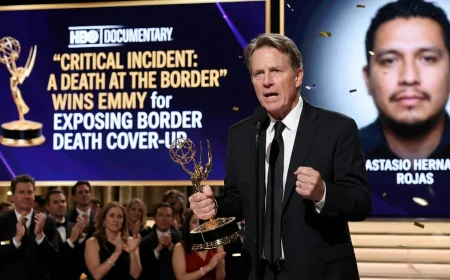
HBO's documentary Critical Incident: A Death at the Border won the Outstanding Investigative Documentary Emmy on June 2, 2026, for exposing the alleged cover-up of a migrant's murder.
- HBO's documentary Critical Incident: A Death at the Border won the Outstanding Investigative Documentary Emmy on June 2, 2026, for exposing the alleged cover-up of a migrant's murder.
- Category: U.S. News
- Published: Jun 2, 2026
HBO Documentary Wins Emmy for Exposing Border Death Cover-Up
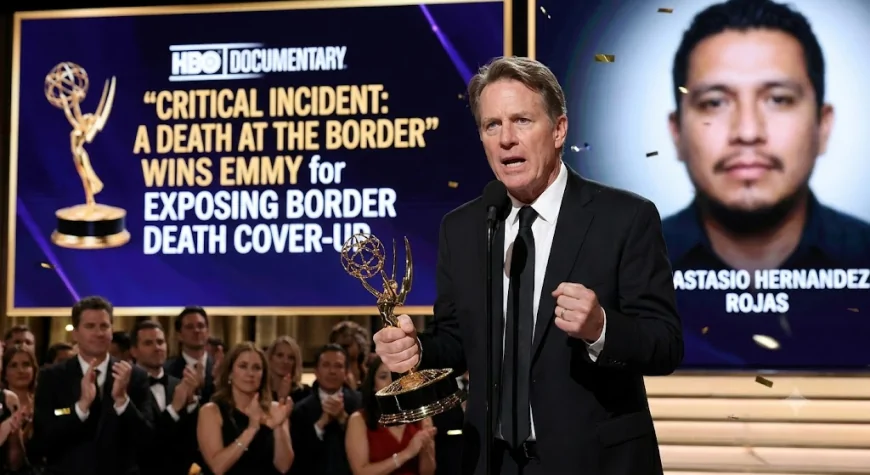
The HBO documentary "Critical Incident: A Death at the Border" won the Outstanding Investigative Documentary prize at the 2026 News and Documentary Emmy Awards on June 2, 2026. The film examines the alleged cover-up of the murder of Anastasio Hernandez Rojas, an undocumented Mexican immigrant who died while in US custody at the border in 2010. His death occurred under the watch of Rodney Scott, the man who now heads Customs and Border Protection under President Trump. The award marks a significant moment for investigative journalism at a time when press freedom faces mounting challenges.
Director Rick Rowley accepted the award with a powerful speech that connected the 2010 killing to current border policies. "Cruelty and violence have festered at the heart of US immigration enforcement for so long, and part of it is because of the impunity and the secrecy that have surrounded these organizations," Rowley stated. "I need to thank this incredible team for pulling back the veil and exposing that organization." The documentary features previously unseen footage and whistleblower testimony that contradicts the official account of Hernandez Rojas's death, which was initially ruled an accident.
The film's subject, Anastasio Hernandez Rojas, was beaten by border agents while handcuffed and lying on the ground. An autopsy found that he suffered a heart attack following the assault, with five broken ribs and a damaged spine. Despite the evidence, no agents were prosecuted for his death. The documentary reveals that several agents involved in the incident were later promoted, including Rodney Scott, who rose to become the chief of the Border Patrol and now serves as the commissioner of Customs and Border Protection. The film's release has renewed calls for a federal investigation into the case.
Documentary's Impact on Border Policy Debate
The Emmy win amplifies the documentary's political resonance. Border policy has been one of the most contentious issues of the Trump administration, with mass deportation operations and the expansion of detention facilities drawing widespread criticism. The documentary's timing, released in early 2026, has made it a reference point for activists and lawmakers opposing the administration's immigration agenda. Several Democratic senators have cited the film in hearings on border agent accountability. The award may encourage other journalists to pursue similar investigations into immigration enforcement.
The film's production was itself a feat of investigative journalism. Rowley and his team spent three years obtaining documents through Freedom of Information Act requests, interviewing dozens of current and former border agents, and tracking down witnesses who had been silent for years. The documentary includes footage from a bystander who recorded the beating on a mobile phone, evidence that was never admitted in previous investigations. According to Dr. Monica Muñoz Martinez, a historian at the University of Texas at Austin, "This film demonstrates the power of documentary journalism to correct official narratives and demand accountability."
The Emmy Awards, held in New York, also recognized several other investigative works. CBS's "60 Minutes" won for a report on the opioid crisis, while PBS's "Frontline" received an award for its investigation into the January 6 insurrection. The diversity of winners reflects a robust ecosystem for investigative journalism despite the financial pressures facing the media industry. However, the recognition for "Critical Incident" stands out for its direct challenge to a sitting administration's policies and personnel. Whether the award leads to tangible policy changes remains uncertain.
Background & Context
Anastasio Hernandez Rojas was a 42-year-old father of five who had lived in the United States for decades before being deported in 2009. He attempted to re-enter the country in May 2010 to reunite with his family. At the San Ysidro border crossing, he was apprehended and beaten by agents while handcuffed. The San Diego Medical Examiner ruled his death a homicide, but the Department of Justice declined to prosecute, citing insufficient evidence. According to a 2024 report from the Government Accountability Project, at least 300 migrants have died in CBP custody since 2010, with few agents facing consequences.
Rodney Scott's career trajectory has drawn particular scrutiny. After the Hernandez Rojas incident, Scott was promoted to deputy chief of the Border Patrol and later to chief. In 2025, President Trump appointed him as commissioner of Customs and Border Protection, the agency's top civilian position. Scott has defended his record, stating that the Hernandez Rojas case was thoroughly investigated and that no wrongdoing was found. The documentary contradicts this claim with new evidence. According to the Border Patrol's own use-of-force guidelines, agents are prohibited from striking handcuffed subjects. The film shows agents doing exactly that.
Frequently Asked Questions
What happened?
HBO's documentary "Critical Incident: A Death at the Border" won the Outstanding Investigative Documentary Emmy on June 2, 2026.
Why does this matter?
The film exposes the alleged cover-up of a migrant's murder by border agents and challenges the official narrative of a current Trump administration official.
Who is affected?
Migrants in CBP custody, border agents facing accountability questions, and viewers whose understanding of border enforcement is reshaped by the documentary.
What happens next?
Congressional Democrats may use the film to push for new oversight legislation, while CBP faces renewed scrutiny of its use-of-force policies.