








































Rep. Tlaib Demands Congress Pass Lebanon War Powers Resolution
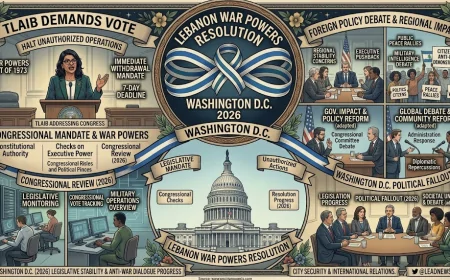
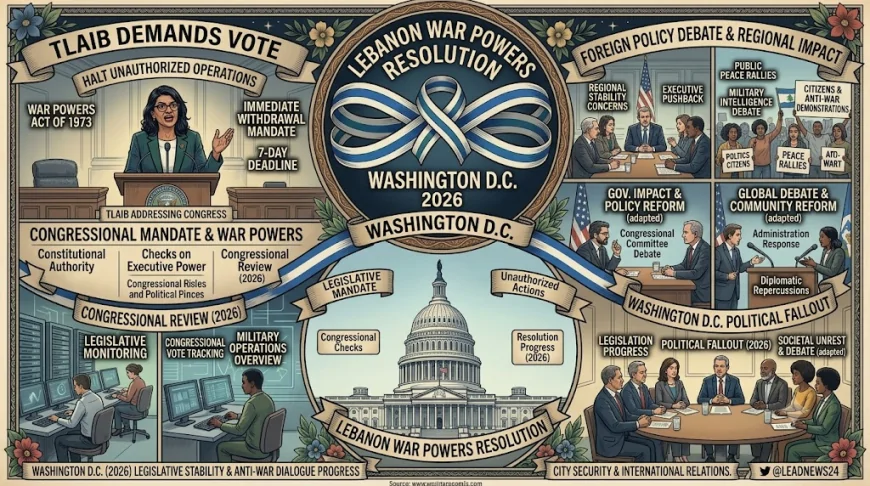
Congresswoman Rashida Tlaib called on Congress to pass a Lebanon war powers resolution on June 2, 2026, amid Israel's continued attacks on Lebanon.
- Congresswoman Rashida Tlaib called on Congress to pass a Lebanon war powers resolution on June 2, 2026, amid Israel's continued attacks on Lebanon.
- Category: U.S. News
- Published: Jun 2, 2026
Rep. Tlaib Demands Congress Pass Lebanon War Powers Resolution
Michigan Democratic Congresswoman Rashida Tlaib called on Congress to pass a Lebanon war powers resolution on June 2, 2026, as Israel's military continued its attacks on Lebanon despite President Trump's claim that both sides had agreed to stop shooting. Tlaib, the only Palestinian American in Congress, wrote in a statement that "our country should not be assisting or supporting indiscriminate bombings and forced displacement anywhere, including Lebanon." Her demand comes as the death toll from Israeli strikes in Lebanon has surpassed 3,400 since March 2, 2026.
The war powers resolution, if passed, would require the Biden administration to withdraw US military support for Israel's operations in Lebanon unless Congress explicitly authorizes continued assistance. Similar resolutions have been introduced in previous conflicts, including the Yemen war, but none have successfully passed both houses. Tlaib's call has been endorsed by several progressive Democrats, including Representatives Ilhan Omar and Alexandria Ocasio-Cortez, but faces stiff opposition from the Republican majority and moderate Democrats who support Israel's right to self-defense.
Tlaib's statement was delivered on the House floor on June 2, just hours after Israeli strikes killed eight people in southern Lebanon, including a dentist and his two children. The congresswoman connected the Lebanon crisis to the broader pattern of US military support for Israel. "We are watching a genocide unfold with our tax dollars and our weapons," she said. "Congress has the power to stop this, and we must use it." Her language was characteristically direct, reflecting her reputation as one of the most outspoken critics of Israeli policy in Congress.
Political Battle Lines and Legislative Prospects
The war powers resolution faces long odds in the Republican-controlled House. Speaker Mike Johnson has indicated that he will not bring the resolution to the floor, calling it "a dangerous attempt to undermine a key ally." Even if the resolution were to pass the House, it would face a filibuster in the Senate, where Republicans hold a majority. President Trump has already threatened to veto any legislation that restricts military aid to Israel. The resolution's primary significance may be symbolic, forcing lawmakers to take a public position on a deeply divisive issue.
However, the political calculus is shifting. Public opinion polls show growing unease with US support for Israel's military operations, particularly among young voters and Democrats. A May 2026 poll from Pew Research found that 54% of Democrats believe the US should reduce military aid to Israel, up from 38% in 2023. The Lebanon crisis, which has produced images of civilian casualties broadcast across social media, has accelerated this trend. Several Democratic senators in competitive races have begun distancing themselves from unconditional support for Israel.
The resolution also highlights the growing influence of the progressive wing of the Democratic Party. Tlaib and her allies have transformed what was once a fringe position into a mainstream debate within the party. According to Dr. Shibley Telhami, a pollster at the University of Maryland, "The progressive caucus has moved the Overton window on Israel-Palestine. What was unthinkable a decade ago is now a serious policy proposal." Whether that shift translates into legislative action depends on the outcome of the November midterms, which could reshape the balance of power in Congress.
Background & Context
The War Powers Resolution of 1973 was designed to check the president's ability to commit the United States to armed conflict without congressional consent. It requires the president to notify Congress within 48 hours of committing armed forces to military action and forbids armed forces from remaining for more than 60 days without congressional authorization. The resolution has been invoked several times since its passage, including during the Kosovo War and the Libya intervention, but its effectiveness has been limited by presidential resistance and judicial reluctance to enforce it.
US military aid to Israel has totaled more than $3 billion annually for decades, making Israel the largest cumulative recipient of US foreign assistance since World War II. The aid includes advanced weapons systems, missile defense technology, and intelligence sharing. According to a 2025 report from the Congressional Research Service, the US has provided Israel with $158 billion in bilateral assistance since 1949. The Lebanon war powers resolution, if passed, would mark the first time Congress has attempted to restrict this aid in the context of an active conflict. The precedent would be significant, regardless of the resolution's immediate impact.
Frequently Asked Questions
What happened?
Rep. Rashida Tlaib called on Congress to pass a Lebanon war powers resolution on June 2, 2026, to halt US support for Israel's Lebanon attacks.
Why does this matter?
The resolution would test congressional willingness to restrict military aid to Israel and could shift the political debate on US Middle East policy.
Who is affected?
Lebanese civilians under Israeli bombardment, US taxpayers funding military aid, and voters whose representatives must take a public stance.
What happens next?
The resolution will likely be blocked in the Republican House, but the debate will influence Democratic platform drafting ahead of the November midterms.