
















































Washington's Dangerous Game in Dhaka: When Pressure Becomes a Policy Blunder
America's pressure campaign on Bangladesh risks backfiring catastrophically. With China embedded and 170 million at stake, Washington is misreading South Asia badly.
- America's pressure campaign on Bangladesh risks backfiring catastrophically. With China embedded and 170 million at stake, Washington is misreading South Asia badly.
- Category: Editor's Choice
- Published: Mar 8, 2026

America's relationship with Bangladesh has shifted from partnership to provocation — and the miscalculation could reshape South Asia's entire geopolitical balance.
By Sheikh Sadeque Ali
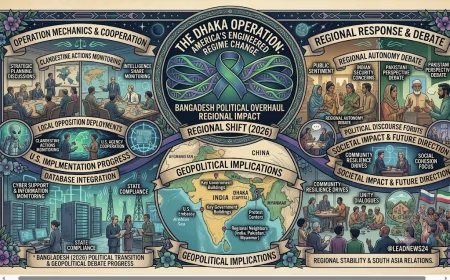
The frequency of high-level meetings between senior officials of Bangladesh's interim government and U.S. Ambassador Peter Haas — and now his successor — has raised eyebrows across Dhaka's diplomatic corridors. What was once routine diplomatic engagement now resembles a sustained pressure campaign, with the U.S. seemingly determined to pull Bangladesh firmly into its orbit, regardless of the cost.
The pattern is unmistakable. American officials have been unusually vocal about Bangladesh's internal governance, its relationship with China, and the strategic value of Saint Martin's Island — a tiny coral island in the Bay of Bengal that sits at a critical maritime choke point. Behind closed doors, sources indicate Washington has floated proposals that would grant the U.S. a strategic foothold there, raising the alarming possibility of Bangladesh being used as a pawn in America's broader Indo-Pacific containment strategy against China.
This is a grave miscalculation.
The China Factor Washington Cannot Wish Away
Bangladesh and China share a relationship built over decades of concrete investment — not rhetoric. China is Bangladesh's largest trading partner and single biggest source of imports, with bilateral trade exceeding $25 billion annually. Chinese firms have financed and constructed critical infrastructure: the Padma Rail Link, the Karnaphuli Tunnel, power plants, and Special Economic Zones.
More critically, geography makes the U.S. strategy structurally flawed. China's presence in the region is not merely economic — it is physical and permanent. The Shwe natural gas field off Myanmar's Arakan coast, operated under Chinese control, sits just miles from Bangladesh's maritime boundary. The China-Myanmar Economic Corridor (CMEC), part of the Belt and Road Initiative, gives Beijing direct overland access toward the Bay of Bengal — an access route that passes alarmingly close to Bangladesh's southeastern frontier.
Any destabilization of Bangladesh, or any attempt to install a U.S.-aligned posture hostile to Beijing, would not deter China. It would simply invite a deeper Chinese strategic response — one that Washington is poorly positioned to counter from this distance.
Saint Martin's Island: The Flashpoint Nobody Is Talking About Loudly Enough
Saint Martin's Island is no ordinary piece of land. At roughly 8 square kilometers, it commands a strategic view of the Bay of Bengal's northern approaches and sits near the entry point of Myanmar's Naf River estuary. Control of — or even privileged access to — this island would provide any power with surveillance capability over critical shipping lanes connecting South and Southeast Asia.
Persistent speculation, fueled by statements from former Bangladeshi political figures including Sheikh Hasina, suggests that U.S. interest in Saint Martin is not incidental. If Washington were to secure any form of military or intelligence presence there — even under the guise of humanitarian or environmental cooperation — it would fundamentally alter the regional security architecture.
China and India would both be compelled to respond. South Asia, already a region of overlapping tensions — the India-Pakistan fault line, the India-China border dispute, the Myanmar civil war — would absorb another destabilizing variable it cannot afford.
A Nation of 180 Million Cannot Be Coerced
The assumption that Bangladesh can be squeezed into compliance betrays a profound ignorance of the country's political psychology. Bangladeshis are not strangers to resisting powerful forces — their very nationhood was forged in blood in 1971 against a far more immediate military threat. The population of over 170 million people, predominantly young, increasingly connected, and deeply nationalistic, will not quietly accept the subordination of their country's sovereignty to foreign strategic interests.
The United States must also reckon with Bangladesh's extraordinary natural resource endowment — significant offshore gas reserves in the Bay of Bengal, vast arable land, the world's largest river delta ecosystem, and a coastline of immense strategic and economic value. Foreign appetite for these resources, dressed up in the language of investment and partnership, is no longer lost on ordinary Bangladeshis. Public skepticism toward Western intentions is already rising.
Coercion is not partnership. And pressure, applied without wisdom, does not produce compliance — it produces resistance.
The Ambassador Must Read the Room
Diplomatic overreach has consequences. The history of American foreign policy in Asia is littered with the wreckage of strategies that underestimated local nationalism and overestimated American leverage. Vietnam. Afghanistan. Iraq. The pattern repeats: an assumption of dominance, a failure to understand the terrain — human and geographic — and an eventual, costly retreat.
Bangladesh is not a satellite state awaiting instruction from Washington. It is a sovereign nation navigating a genuinely complex environment — balancing relationships with China, India, the United States, and the Muslim world simultaneously, with considerable skill.
If the U.S. Ambassador — and the administration he represents — continues to treat Dhaka as a chess piece rather than a partner, Washington will not win the board. It will simply find itself without a player at the table at all.
When you squeeze a lemon too hard, you get nothing but bitterness. America would do well to remember that — before the damage becomes irreversible.
This is an opinion and analysis piece reflecting geopolitical commentary on U.S.-Bangladesh relations.