

























Putin Returns to Moscow With 'Air of Triumph' After Summit, Rattling West
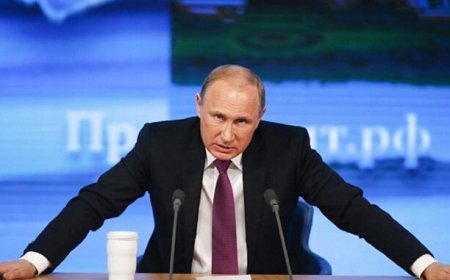
President Vladimir Putin returned to Moscow with an 'air of triumph' following a high-stakes summit, as Western allies express concern over his maximalist goals in Ukraine.
- President Vladimir Putin returned to Moscow with an 'air of triumph' following a high-stakes summit, as Western allies express concern over his maximalist goals in Ukraine.
- Category: Russia
- Published: Feb 26, 2026
Kremlin Leader Projects Confidence as Diplomatic Engagements Signal Shifting Alliances
President Vladimir Putin arrived back in Moscow today carrying what observers describe as an unmistakable \"air of triumph\" following a high-profile international summit. The Russian leader's demeanor and the subsequent readouts from the meetings have sent a chill through Western capitals, reinforcing fears that Putin's ambitions extend far beyond territorial conquest and aim at the complete capitulation of Ukraine. The summit, held in Alaska, was seen as a key test of Putin's ability to re-engage on the world stage despite ongoing sanctions and the war.
Details emerging from the closed-door sessions suggest Putin was in a confident, even assertive, mood. He reportedly dismissed Western concerns about the war's trajectory and doubled down on his demands, which include not just Ukrainian territory but a fundamental rewrite of the European security order. This posture has alarmed Kyiv and its allies, who see it as proof that Putin believes time is on his side and that Western resolve is weakening.
The Russian president's travels, though limited to a few countries since the invasion of Ukraine began, are now being closely watched as indicators of his strategy. His ability to secure meetings with leaders from the Global South, coupled with growing domestic fatigue in Europe over the cost of supporting Ukraine, has bolstered the Kremlin's belief that it can outlast the current coalition arrayed against it. The \"triumph\" noted by observers is less about concrete gains at the summit and more about the sheer fact of his presence and the perception that he has weathered the storm.
The Kremlin's Maximalist Goals: More Than Land
Western intelligence assessments, cited in reports accompanying the summit coverage, warn that Putin's war aims have not diminished. He is not merely seeking to solidify control over the Donbas and Crimea. His objective, analysts believe, is to render Ukraine a failed state, incapable of resisting Russian influence, and to force NATO to roll back its presence in Eastern Europe. This is the \"capitulation\" that Kyiv and its allies fear—a peace imposed on Ukrainian terms, effectively erasing its sovereignty.
Putin's public statements have consistently framed the war as an existential struggle against Western decadence and expansionism. This ideological framing leaves little room for compromise. For the Kremlin, any peace that leaves a pro-Western, independent Ukraine intact is a defeat. The maximalist goals are not just rhetoric; they are embedded in the structure of the Russian state's propaganda and military planning.
According to Tatiana Stanovaya, founder of the political analysis firm R.Politik, \"Putin is not looking for a way out. He is looking for a way to win. He genuinely believes that history is on his side and that the West, with its short attention spans and electoral cycles, will eventually tire of the conflict and move on. His 'triumph' is the triumph of patience and ruthlessness over what he sees as Western decadence and indecision.\" This analysis suggests that diplomatic efforts to find a negotiated settlement will continue to hit a wall of Russian intransigence.
Ukraine and the West Brace for a Long War
For Ukraine, the images of Putin striding confidently on the international stage are deeply unsettling. President Zelenskyy has repeatedly warned that any pause in fighting or reduction in Western support will simply allow Russia to rearm and attack again. The Ukrainian military, facing ammunition shortages and manpower challenges, is desperately trying to hold the line while preparing for a potential Russian summer offensive. The mood in Kyiv is grim but determined.
European nations are caught in a difficult bind. They want to support Ukraine, but domestic political pressures are mounting. Far-right and far-left parties, often sympathetic to Moscow, are gaining ground in several countries, questioning the endless flow of weapons and money. The US, with its own election looming, faces similar political fragmentation. The unity of 2022 has frayed, replaced by a grinding, expensive stalemate.
The question now is whether Putin's perception of triumph is accurate or a dangerous miscalculation. If the West holds firm and continues to supply Ukraine, the war could grind on for years, bleeding Russia as much as Ukraine. If support falters, Putin's maximalist goals may yet be achieved. As the Russian president lands in Moscow, the future of European security hangs in the balance. Will the West prove Putin wrong, or will his gamble on its weakness pay off?