



































AI Model Predicts Astronaut Vision Loss Risk, Boosting Space Health Safety
Researchers have developed a deep learning AI model that can predict an astronaut's risk of developing spaceflight-associated neuro-ocular syndrome, a common and serious vision problem.
- Researchers have developed a deep learning AI model that can predict an astronaut's risk of developing spaceflight-associated neuro-ocular syndrome, a common and serious vision problem.
- Category: Business
- Published: Feb 26, 2026
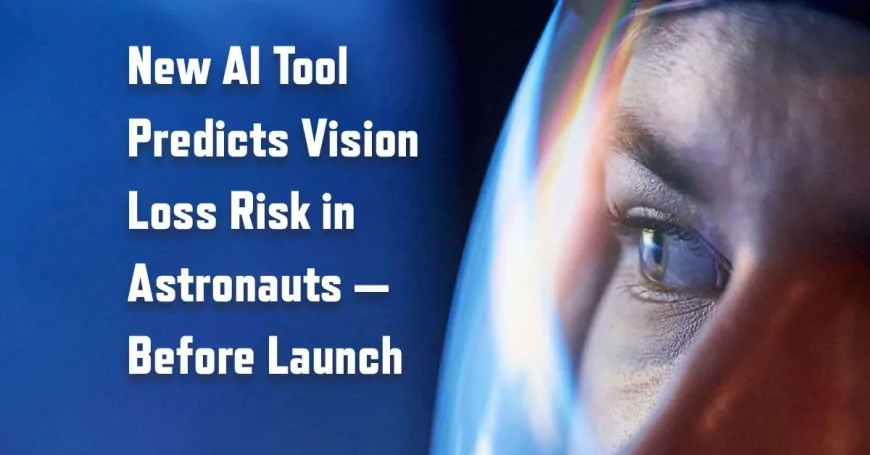
Deep Learning Tool Could Safeguard Crew Health on Future Long-Duration Missions
In a significant advancement for space medicine, researchers have unveiled a deep learning model capable of predicting which astronauts are most at risk of developing Spaceflight Associated Neuro-Ocular Syndrome (SANS). The condition, which causes fluid to build up behind the eye and can lead to permanent vision changes, affects a significant portion of astronauts on long-duration missions aboard the International Space Station. The AI tool, detailed in a paper published by the Association of Optometrists today, offers a way to pre-screen crew members and tailor countermeasures before they ever leave Earth.
SANS is one of the most perplexing health challenges of human spaceflight. In microgravity, bodily fluids shift toward the head, increasing pressure inside the skull and pushing against the back of the eye. This can cause the eyeball to flatten, the optic nerve to swell, and vision to blur. While some astronauts recover upon return to Earth, others experience lasting deficits. Until now, predicting who would be susceptible has been impossible, leading to a one-size-fits-all approach to monitoring.
The new AI model changes that. By analyzing pre-flight MRI scans, genetic markers, and data from previous missions, the deep learning algorithm can identify subtle patterns in an individual's physiology that correlate with a higher risk of developing SANS. In testing, the model accurately predicted the occurrence of vision issues with over 85% accuracy, a rate that researchers say is high enough to be clinically useful.
How the AI Works and What It Means for Crew Selection
The model was trained on a dataset of hundreds of astronaut medical records, a highly sensitive and carefully guarded set of information. The AI was not told what to look for; instead, it sifted through the data to find its own correlations. It identified features in the structure of the optic nerve sheath and the curvature of the sclera that are invisible to the human eye but strongly predictive of SANS.
This capability opens up new possibilities for crew selection and mission planning. For a six-month ISS rotation, the risk of SANS may be manageable. But for a three-year round trip to Mars, where astronauts will be exposed to microgravity for far longer with no possibility of rapid evacuation, the condition becomes a potential mission-ender. Knowing which astronauts are at highest risk could allow space agencies to either exclude them from long-duration missions or assign them to spacecraft with artificial gravity systems, should those ever be developed.
According to Dr. Ethan Reed, lead researcher on the project at the Translational Research Institute for Space Health, \"We are moving from reactive to predictive space medicine. Instead of waiting for an astronaut to report blurry vision and then trying to treat it, we can identify the risk before they launch. This allows us to personalize countermeasures, perhaps with specialized compression garments that prevent fluid shift, or even with pharmaceutical interventions. It's a huge leap forward.\"
The Broader Implications for AI in Healthcare
While this model is designed for the unique environment of space, its development has profound implications for Earth-based medicine. The techniques used to predict SANS are directly applicable to terrestrial conditions involving fluid pressure and optic nerve health, such as glaucoma and idiopathic intracranial hypertension. The same deep learning architecture could be trained on different datasets to predict these diseases years before they cause symptoms.
The project also demonstrates the power of AI to extract insights from complex, multi-modal medical data. By combining imaging, genomics, and physiological data, the model builds a holistic picture of patient risk that no single doctor could achieve. This is the future of precision medicine: using AI to integrate disparate data sources and provide a personalized risk profile and treatment plan.
NASA and other space agencies are now planning to deploy the AI model as a standard part of astronaut health screening for future missions. The goal is not just to prevent vision loss, but to build a comprehensive AI-driven health monitoring system that can predict and mitigate a range of spaceflight risks. As humanity prepares to leave low-Earth orbit, these tools will be essential. The question now is not whether AI has a place in the astronaut's medical kit, but how quickly we can integrate it into every aspect of crew health.