






































Iowa Mass Shooting Kills Seven Including Gunman in Muscatine
A gunman killed six people before being shot dead in spree shootings across Muscatine, Iowa on June 2, in one of the state's deadliest mass shootings.
- A gunman killed six people before being shot dead in spree shootings across Muscatine, Iowa on June 2, in one of the state's deadliest mass shootings.
- Category: U.S. News
- Published: Jun 2, 2026
Gunman Kills Six in Muscatine Iowa in Deadly Spree Shooting
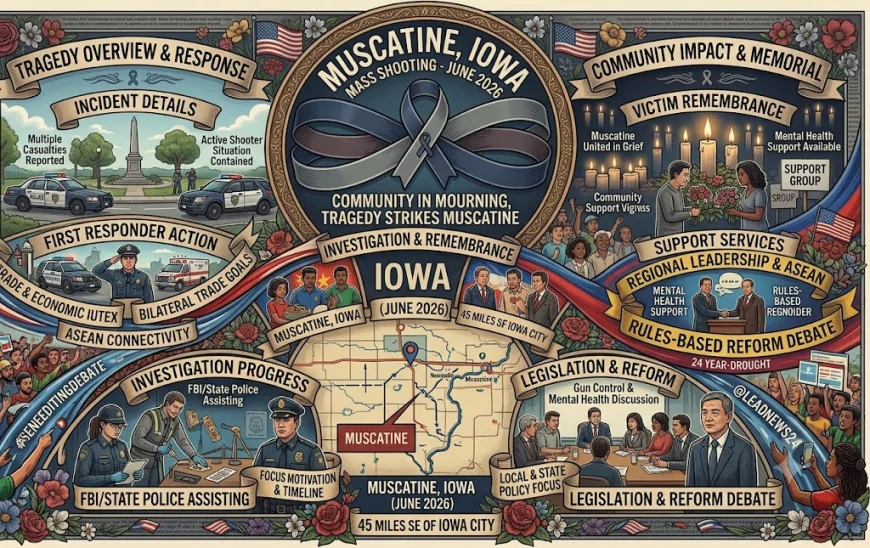
A gunman killed six people and wounded several others in a series of shootings across Muscatine, Iowa on the evening of June 2, 2026 before being shot and killed by law enforcement. The incident, which unfolded across multiple locations in the small city over approximately 90 minutes, is one of the deadliest mass shootings in Iowa's history and follows a pattern of gun violence striking mid-sized American cities that have not historically been associated with high rates of firearm homicide.
Muscatine is a city of approximately 24,000 people located on the Mississippi River in eastern Iowa. Local police, supported by Iowa State Police and federal agents, responded to multiple 911 calls reporting active shooting incidents before locating and confronting the gunman, who was killed in an exchange of fire with officers. No law enforcement personnel were reported injured.
Muscatine County Sheriff's Office confirmed the death toll of six victims plus the gunman, with at least four additional people hospitalised with gunshot wounds. The identity of the gunman had not been publicly released as of June 3 morning, pending notification of family. A motive had not been established. Investigators were examining the gunman's social media history and communications for indicators of planning or grievance-based motivation.
The Shooting Sequence and Law Enforcement Response
The shootings began at approximately 7:45 PM local time at a residential address in a neighbourhood near downtown Muscatine. Police responding to that call received a second report of shots fired at a commercial location approximately half a mile away before the first scene was secured. A third shooting location was reported within the same 15-minute window.
Iowa Governor Reynolds activated the Iowa National Guard's Critical Incident Response Team and issued a statement expressing condolences to the victims' families and calling for prayers for the Muscatine community. She did not address gun policy in her statement. Senator Chuck Grassley posted condolences on X without policy comment. Iowa's Democratic US House members called for congressional action on assault weapons regulation.
According to David Harris, professor of law and executive director of the gun violence research programme at the University of Iowa, "Muscatine is not a city that appears in national gun violence statistics as a high-risk location. That's precisely the point. The geographic spread of mass shooting incidents across American cities of all sizes and demographics is one of the most important and least-discussed features of this crisis." The United States recorded over 600 mass shootings in 2025, continuing a decade-long pattern in which the annual total has consistently exceeded the number of days in the year.
Community Impact and Response
Muscatine's downtown area was placed on lockdown for several hours while law enforcement cleared each shooting location. Schools in the district activated emergency protocols and parents gathered outside to collect children who had been sheltering in place during after-school activities. Local hospitals activated their mass casualty response plans, with UnityPoint Health Muscatine receiving four of the gunshot wound patients.
Community vigils were being organised for the evening of June 3. Local clergy, the mayor, and city council members planned to attend. The Muscatine Community School District announced that counsellors would be available at all schools on June 4 for students and staff affected by the events.
The shooting immediately entered the national political news cycle, with gun control advocacy groups and Second Amendment organisations both issuing statements within hours. The timing — with Congress in session and the One Big Beautiful Bill Act's implementation creating other political pressures — makes the likelihood of legislative action on gun policy in the near term extremely low based on recent congressional response patterns.
Background and Context
Iowa has relatively permissive gun laws by national standards, having passed constitutional carry legislation in 2021 that removed the requirement for a permit to carry a handgun in public. The state does not have a red flag law allowing courts to temporarily remove firearms from individuals deemed a danger to themselves or others — a tool that gun violence researchers have found can reduce certain categories of firearm violence when properly implemented.
According to the Gun Violence Archive, which tracks gun violence incidents in the United States, Iowa recorded 37 gun deaths in the first five months of 2026. That figure does not include the Muscatine shooting, which is expected to push the state's year-to-date total to over 40 gun deaths for a state with a population of approximately 3.2 million. The national gun death rate in the US significantly exceeds that of any comparable high-income democracy.
The Muscatine community will face a long recovery process. Small cities that experience mass shootings often find that the psychological impact — the erosion of the sense of safety in familiar public spaces — is more persistent and harder to address than the physical damage of the event itself. Mental health resources for first responders and surviving community members will be a critical need in the weeks and months ahead.
Frequently Asked Questions
What happened?
A gunman killed six people in a series of spree shootings across Muscatine, Iowa on the evening of June 2, 2026, before being shot dead by law enforcement. Four additional people were hospitalised with gunshot wounds. A motive had not been established as of June 3.
Why does this matter?
The shooting underscores the pattern of mass gun violence striking American communities of all sizes and demographics. Muscatine, a city of 24,000, had not previously experienced an incident of this scale, illustrating the nationwide geographic spread of the mass shooting crisis.
Who is affected?
Six victims and their families, the wider Muscatine community of 24,000, first responders managing trauma, local schools and businesses, and the national political debate over gun regulation are all directly affected by this incident.
What happens next?
Investigators will establish the gunman's identity, motive, and the legal history of the firearms used. Community recovery efforts begin with vigils on June 3. Congressional response is expected to follow the established pattern of statements without legislative action in the near term.