

























Trump Admin Transgender Military Ban Struck Down by Appeals Court
A divided US appeals panel ruled on June 2 that the Trump administration's transgender military ban was illegal, affecting 15,000 serving troops.
- A divided US appeals panel ruled on June 2 that the Trump administration's transgender military ban was illegal, affecting 15,000 serving troops.
- Category: U.S. News
- Published: Jun 2, 2026
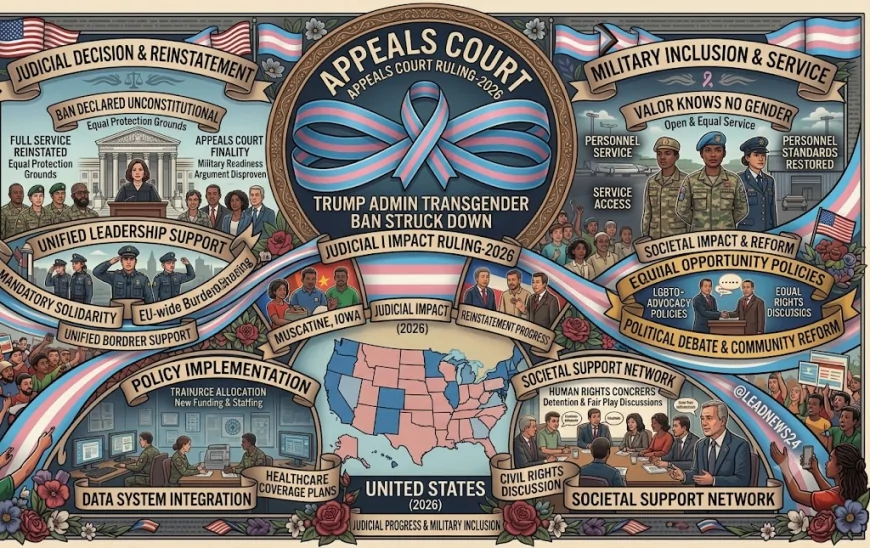
Federal Appeals Court Strikes Down Trump Transgender Military Ban
A divided panel of federal appeals court judges ruled on June 2 that the Trump administration's policy banning transgender individuals from serving in the United States military was enacted illegally and violates federal anti-discrimination law. The ruling, issued by a three-judge panel with two judges in the majority and one dissenting, represents the most significant judicial setback for the administration's military gender policy and will almost certainly be appealed to the Supreme Court.
The majority opinion held that the executive order implementing the ban failed to provide adequate justification under the legal standard required for policies that treat individuals differently based on protected characteristics, and that the administration's stated rationale — unit cohesion and military readiness — was not supported by the factual record before the court. The dissenting judge argued that courts should defer to the executive branch's military judgment on personnel policy.
The ruling affects an estimated 15,000 transgender service members currently serving in the US Armed Forces, who had been operating under a series of contradictory policies as legal challenges worked through the courts. The Pentagon has not yet responded officially to the ruling.
The Legal and Political History of the Ban
The Trump administration's effort to exclude transgender service members from the military has been contested in federal courts since its initial announcement in 2017 during Trump's first term. The Obama administration had moved to allow open transgender service in 2016. Trump reversed that policy via tweet and executive order in 2017, triggering immediate court injunctions. The Biden administration reversed the ban again in 2021. Trump's return to the presidency in 2025 led to the third iteration of the ban, which has now been struck down by the appeals panel.
According to Shannon Minter, legal director at the National Center for Lesbian Rights and a veteran of transgender military service litigation, "This ruling matters because it applies a rigorous evidentiary standard to the government's military justification claims and finds them legally insufficient. That creates a precedent that will be difficult to overcome even if the case reaches a more conservative Supreme Court bench." The Trump administration issued a series of executive orders affecting military personnel policy in its first 100 days, including the transgender service ban and orders affecting diversity programmes and conscientious objector procedures.
Six states — California, Iowa, Montana, New Jersey, South Dakota, and Vermont — had filed amicus briefs supporting the legal challenge. The practical implications for service members in those states will be felt most immediately following the ruling, though a stay pending appeal may freeze the decision's effect for months.
Military Readiness Arguments on Both Sides
The administration's legal team argued throughout the case that allowing transgender service members to serve creates operational complications related to medical requirements, deployment readiness, and unit cohesion. Critics of the ban, including several retired generals and admirals who filed declarations in the case, argued the opposite — that open transgender service since 2016 produced no evidence of degraded readiness and that the ban itself reduces readiness by excluding qualified individuals from service.
The RAND Corporation's landmark 2016 study, repeatedly cited in court filings, estimated that allowing transgender individuals to serve openly would have minimal impact on readiness or costs. No subsequent empirical study has contradicted those findings, and the court's majority opinion referenced this body of evidence in finding the administration's readiness justification legally inadequate.
The Department of Defense is currently managing active military operations in Lebanon's aerial support role and in the broader Iran war theatre. Senior military commanders have been notably restrained in public comments about the transgender ban throughout its implementation, a silence that some observers interpret as institutional discomfort with a policy perceived as creating personnel management problems rather than solving them.
Background and Context
The question of transgender military service has been one of the most litigated military personnel policy questions in recent American legal history. The oscillation between administrations — open service under Obama, ban under Trump, open service under Biden, ban again under Trump — has created a climate of uncertainty that has deterred some qualified transgender individuals from enlisting even during periods when service was officially permitted.
According to the Williams Institute at UCLA School of Law, approximately 134,000 transgender adults have served in the US military at some point in their lives, and an estimated 15,000 are currently serving. The Institute's research has consistently found that transgender service members are deployed at rates comparable to non-transgender peers and receive military honours and commendations at similar rates.
The Supreme Court, which previously upheld an earlier iteration of the ban in 2019 on procedural grounds, will likely be asked to review this ruling. The court's current composition, shaped by Trump's first-term appointments, creates genuine uncertainty about the outcome of any Supreme Court review of a ruling that applied heightened scrutiny to a presidential military personnel decision.
Frequently Asked Questions
What happened?
A divided federal appeals court panel ruled on June 2, 2026 that the Trump administration's policy banning transgender individuals from US military service is illegal, finding the stated readiness justifications legally insufficient and ordering the ban be struck down.
Why does this matter?
The ruling affects approximately 15,000 transgender service members currently in uniform. It applies a legal standard that could constrain future executive authority over military personnel policy and will almost certainly reach the Supreme Court for final resolution.
Who is affected?
15,000 transgender active duty service members face immediate uncertainty about their status. The Trump administration faces a significant legal setback. The Pentagon must respond to conflicting legal obligations pending appeal. Six states that filed supporting briefs have immediate implementation interest.
What happens next?
The administration will file an emergency stay request to freeze the ruling pending appeal. The case will almost certainly be petitioned to the Supreme Court. A decision on certiorari — whether the court agrees to hear the case — could come within months, with oral arguments potentially in the October 2026 term.