























FIFA World Cup 2026 Squad Announcements Draw Global Attention
Nations are finalising squads for the FIFA World Cup 2026 kickoff on June 11, with Messi's farewell and England selections dominating global debate.
- Nations are finalising squads for the FIFA World Cup 2026 kickoff on June 11, with Messi's farewell and England selections dominating global debate.
- Category: World News
- Published: Jun 2, 2026
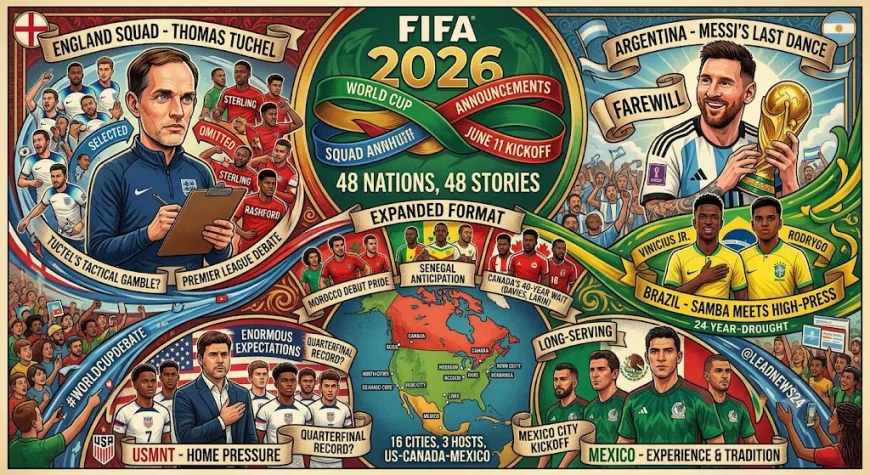
World Cup 2026 Squad Announcements Ignite Global Football Debate
The FIFA World Cup 2026 is now eight days away. Across 48 participating nations, coaches have been finalising their squads for the tournament that kicks off on June 11 in Mexico City, and the announcement season has delivered the controversies, surprises, and moments of collective national anticipation that only a World Cup can generate. From England to Brazil, Argentina to Japan, the stories behind who made the squad — and who didn't — are driving the global football conversation in the final week before the opening whistle.
This World Cup marks the debut of the expanded 48-team format, which adds 16 new nations to the tournament compared to previous editions. For football fans in debut nations including Morocco, Senegal, and several Central American countries, the squad announcement is not just sporting news — it is a moment of genuine national pride that transcends the sport itself.
England's squad, announced by manager Gareth Southgate's successor Thomas Tuchel earlier this week, generated the most debate in the English-language football media. The omission of several high-profile Premier League performers in favour of younger players Tuchel believes suit his tactical system drew criticism from former internationals while earning praise from analysts who have watched England's training camp closely.
The Big Nations and Their Key Stories
Brazil enters the tournament without its traditional generation of attacking superstars following the retirements of Neymar and other veterans from the 2018 and 2022 squads. The new Brazilian generation, led by Vinicius Jr. and Rodrygo, carries enormous expectation but also a different playing identity — more physically direct and high-pressing than the samba football of previous eras. Brazil has not won a World Cup since 2002 and the 24-year drought has created genuine national urgency.
Argentina arrives as the defending champion following its 2022 Qatar victory. Lionel Messi, now 38, confirmed his participation in what will almost certainly be his final World Cup. His fitness and form through a gruelling Inter Miami season have been closely monitored. Argentina's coach Lionel Scaloni has built a squad that can function at a high level with or without Messi's peak performance — a tactical maturity that the 2022 victory demonstrated fully.
According to Tim Vickery, South America football correspondent for BBC Sport, "This tournament has a different feel from any previous World Cup because the expanded format genuinely gives 48 nations a realistic path to the knockout stage. That changes the tactical calculus, the emotional investment, and the potential for upsets in ways that the established football nations have not fully processed." The FIFA World Cup 2026 is hosted across 16 cities in the United States, Canada, and Mexico, making it the first World Cup with three co-hosts and by far the most geographically dispersed tournament in the competition's history.
The Host Nations and Their Chances
The United States men's national team has never advanced past the quarterfinals of a World Cup, with a 2002 run representing the high watermark. The 2026 tournament, played on home soil with enormous crowds in stadiums built for American football, represents the most favourable conditions the USMNT has ever had — and the most pressure. Manager Mauricio Pochettino has built a squad around the core of players who were teenagers during the 2022 Qatar campaign, now entering their prime years.
Canada qualifies for its first World Cup since 1986, with a squad built around Bayern Munich midfielder Alphonso Davies and Fulham striker Cyle Larin. Canadian football fans have waited 40 years for this moment, and the squad announcement generated television coverage and social media engagement that dwarfed anything the country's football programme had previously achieved. Mexico, a perennial World Cup participant, enters as the third co-host with the most experienced squad of the three.
The tournament format means every nation plays at least three group stage matches, giving fans and teams the sustained engagement that a single-match elimination would deny. Group stage results through late June will determine which 32 nations advance to the knockout rounds, beginning the condensed schedule that produces the tournament's iconic moments.
Background and Context
The FIFA World Cup was expanded from 32 to 48 teams by FIFA's Congress in 2017, a decision driven primarily by commercial and political considerations — more teams means more participating nations' broadcasters pay rights fees, and more association presidents benefit from their nations' inclusion. Critics argued the expansion would dilute quality; proponents argued it would democratise the world's most watched sporting event.
According to FIFA's 2025 global football participation report, football is the most played sport on earth with 270 million registered players. The World Cup final is consistently the most watched television event globally, with the 2022 Qatar final drawing an estimated 1.5 billion viewers. The 2026 edition, in North America's large media market with English, Spanish, and French as co-official tournament languages, is projected to shatter viewership records. Broadcasting rights for the 2026 tournament were sold at a combined value of approximately $5 billion — the highest in the competition's history.
Eight days from kickoff, the football world's attention is fully focused on North America. The squad stories, tactical previews, and travel logistics for fans covering thousands of miles between group stage venues are all building toward the moment on June 11 when the opening match whistle blows in Mexico City and the competition begins.
Frequently Asked Questions
What happened?
Nations are finalising their squads for the FIFA World Cup 2026, which kicks off June 11. High-profile inclusions, omissions, and storylines including Messi's final World Cup and England's tactical selection debate are dominating global football coverage eight days before the tournament begins.
Why does this matter?
The World Cup is the most watched sporting event on earth. The 2026 edition's expanded 48-team format and North American hosting — across three co-host nations and 16 cities — makes it the most geographically and commercially significant tournament in the competition's history.
Who is affected?
Fans of 48 nations across six continents, 16 North American host cities, broadcasters holding $5B in rights, sponsors, and the global hospitality and travel industry all have direct stakes in the tournament's eight-day countdown and subsequent eight weeks of competition.
What happens next?
The opening match kicks off in Mexico City on June 11. Group stage fixtures run through late June. The first knockout round begins in early July, with the final scheduled for July 19 at SoFi Stadium in Los Angeles.